You’ve Been Practicing Harmony Wrong… (feat. Luther Allison)

Ever heard someone playing harmony that just makes you say “what is THAT? And how do I do it, too?” Well today we’re going to walk you through a clear practice plan for developing real jazz harmonic concepts.
Harmony can feel very complicated. There are so many different things to focus on, especially as a pianist—with so many different styles and approaches to accompaniment and to learning and understanding harmony and melody. A lot of people experience difficulty finding a practice routine that can help all of these different concepts stick.
We’re going to help give you a structured plan to really understand each of these concepts and get them into your playing. Oftentimes, people will learn some of these concepts but not understand how and when to use them in the context of playing a standard or playing with other musicians.
Everything we talk about today can be found in our resource 30 Day Jazz Harmony Chops, which provide you with a simple day-by-day plan where every session focuses on three things: a technical warm up, our harmonic concept, and direct applications to a tune. So everything that we cover is going to be accompanied by sheet music along with overhead video, so you can see everything in the moment.
And if you want to follow along with Luther as he plays through the exercises we talk about, make sure to check out our accompanying YouTube video You've Been Practicing Harmony Wrong... (feat. Luther Allison).
Now let’s get playing!
Contents
Drop 2 major shapes
Let’s look at some drop two major shapes. So drop two, if you're unfamiliar with this, is going to be rooted in block chords, initially just a one-handed block chord.
Let’s take a Dm7 voicing.

If we were to do a drop two, all we’re doing is taking the second note from the top and moving it below that voicing really just down by one octave.
We can move this around diatonically.

It just opens up the soundscape a lot. If we want to do it over C major:

This opens things up a little bit more, as opposed to our block chords.

Block chords are also really pretty and closer together, a little more dense, a little a little warmer. But there’s a little bit more sparkle whenever you use some of these drop two voicings.
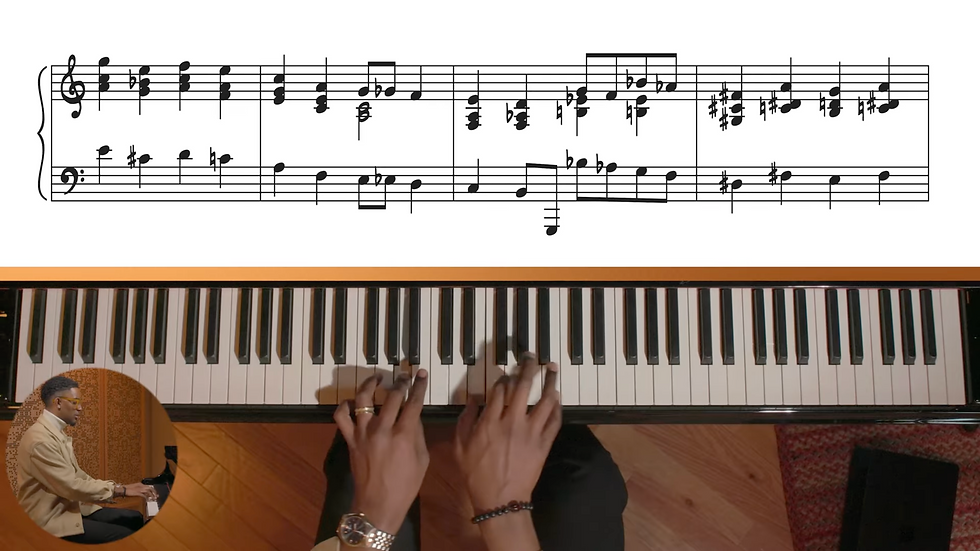
And if we want to take this through a pattern, we might just play something like this.

It's a really beautiful sound.


Quartal voicings
All right, now let’s do some exercises using quartal voicings (not chordal!). These are voicings comprised of fourths. So for your open fourth quartal voicings, this is a sound that is rooted in Dorian. So let’s take the C Dorian scale:

And we just build up the voicing in fourths. But we’ll actually build from the top down. We start with C and go down in fourths. Now the interesting thing here is when you hit this A you would go down a perfect fourth to E, but that's not within the Dorian scale, so you would actually go down to E flat. And all we have to do is move this exact sound up through the scale.

A good way to work on this is by doing one hand at a time.

And we split it up as two notes in the left hand, three notes in the right hand.

You can do different things like that, where you play around with the pattern. So instead of moving diatonically you can skip.

Sometimes you may want to start with the “So What” voicings, which is what we call them.
Upper structure triads & altered harmony
Another great harmonic concept that we cover in the course is upper structure triads and altered harmony.
Let’s start with dominant chords. Whenever we think about extensions on dominant chords, there are so many different directions that you can go with it. Let's go to Eb7.

We can use different triads that are going to highlight certain sounds and certain alterations from those chords. So if we play a B triad, it's going to give us a #9/#5. If we play an A major triad, pay attention to the spacing as well, because you don't want to play high up (unless you're doing a pattern and you're working your way down).
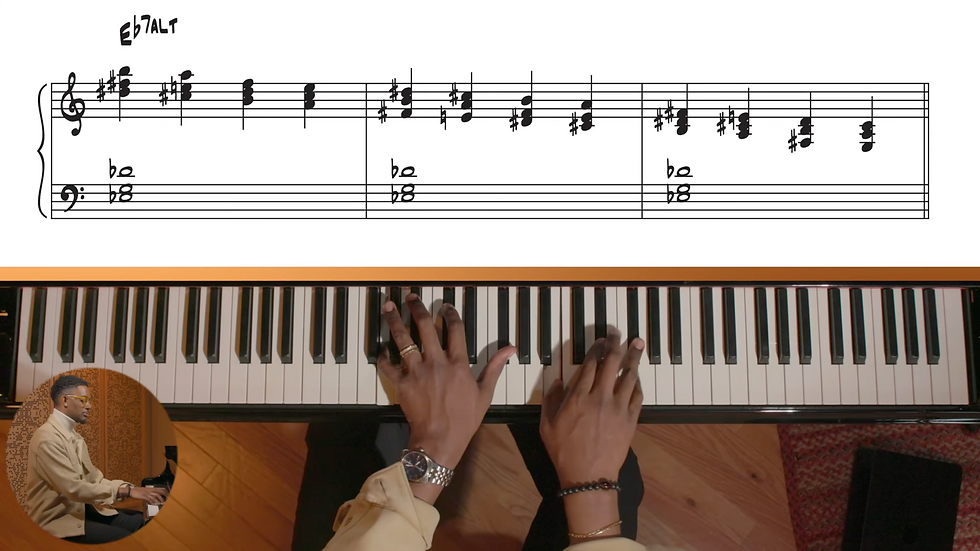
But a lot of these triads are going to give you your b9/b5. An F major triad is going to give you your 9, 13, and #11.

A Db triad is going to give you a sus sound. The funny thing is, you can still use this over an Eb7 chord, and you can have that cluster in there. It’s great to use with that quartal voicing, like we used before, but you still kind of have that Db in there.
We can fill it out with the F to make it a little more full and a little more dense.
And as you can see, there are so many different triads that you can put on top of the chord that will give you so many different sounds and shapes. Now, if we look at a song like “Stella by Starlight,” there are certain points in the melody where the top note is falling on chord tones that are outside of just the 1, 3, 5, and 7, so even at the very beginning of the song, we fall on the 11.
There's that spread voicing, again that we spoke about.

And we can just take advantage of that D major sound.

Then we can bring that out with each of these voicings, thinking of all of the different ways that we can voice these chords with different alterations within them.

So for example, that first chord, that A could be a #9/#5. It could be a b9/b5 or we could make it sus.
Voice leading with block chords
Now, let’s add more voice leading in our block chords. It's a similar concept that we spoke about before, where you can adjust some of the chords so you can lead into the next chord. For example, if you have the tune All the Things You Are.
You can do some things where you slightly reharmonize the song, not a whole lot, but you can start to approach some of the chords by maybe a dominant chord a half step above, or you can change the chord that you're sitting on.

For example, your first chord being an Fm7, leading to your Bbm7. This could be a little more of a soloistic thing, or taking more liberties within the song.

You can make that Fm7 into an F7b9 and also add some more clusters within the chords.

That time we went into that Cm with some G7 language.


Also adding some more tension to some of those chords.

Maybe even resolving the chord a little bit later. You can find little things like that and slightly adjust how you interpret the melody or how you solo over the song.
Comping
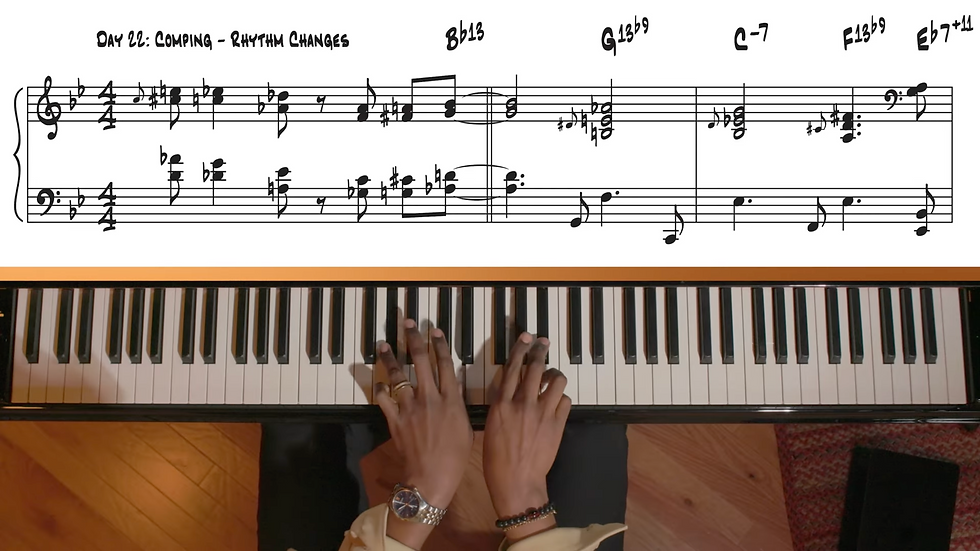
For this next concept, let's get into comping—how to make your chords sound alive and supportive with strong voicings and rhythmic textures. For this warm up, we’ll start off with some comping exercises. So when comping, a really important thing to consider is going to be your rhythm.
For that reason, let’s check out Rhythm changes, a I-vi-ii-V, focusing on that turnaround and having good rhythm. We’ll use some of the concepts we spoke about before, like drop two voicings, block chords, and inner voice movement as well.


Sus & Phrygian dominant
For the next concept, let's talk about Sus and Phrygian dominant.
With Phrygian dominant, there are some beautiful sounds that you can get out of this. This is actually your fifth mode of your harmonic minor scale.

So if you play your harmonic minor scale, you would just start from the 5.

This is something you can use over a sus flat nine voicing.


And you can also do some interesting patterns.
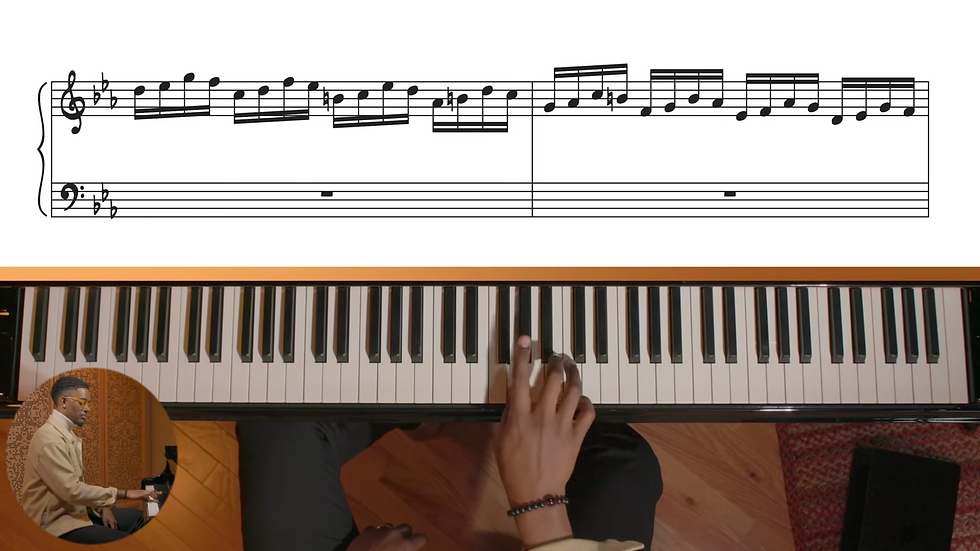

Also try using patterns where you skip notes.


And as you can see, we can also use it over the Abmaj7.

And that is your Phrygian dominant scale.

Playing horizontal
When we’re playing vertically, we’re referring to stuff that is arpeggio-based. But then if we're going to play horizontally through changes, that means playing more melodically, diatonically, sometimes even chromatically.
Here’s what Blue Bossa looks like vertically, with arpeggios.


Now let’s try to play through the changes using some of the scales. A big part of this is understanding the scales that you can use over each of these chords. A lot of m7 chords, you can use the Dorian sound. For your 7 chords, try using a Lydian sound or even some of the altered sounds.


A really good exercise is just trying to play scales in one direction through all of the chords.


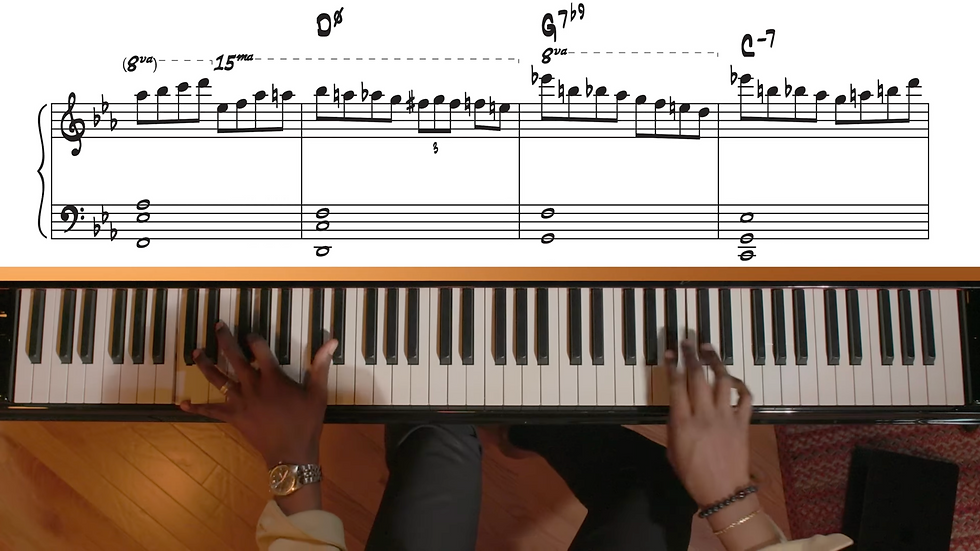
You can also make it a little more interesting and change some of the harmony.

The difference between both of these is that we’re connecting all of the chords. Sometimes another really helpful tool is changing some of the chords to lead us into the next one. So here we start with our Cm7.

And we’re even playing some G stuff.

Well that’s all we have for today, but there’s so much more to discover in our 30 Day Jazz Harmony Chops resource. And make sure to check out our accompanying YouTube video You’ve Been Practicing Harmony Wrong… (feat. Luther Allison) if you want to see how Luther plays through any of the examples we talked about.
We’ll see you next time!


Comments