Stop Neglecting Stride: Accessible Techniques for Jazz Pianists (feat. William Hill III)
- Jazz Lesson Videos

- Feb 2
- 4 min read
Today, we’ll look at one of the most important styles in the history of jazz. It laid the foundation for swing, bebop, and countless piano traditions that followed. And that is Stride. Stride piano was born from Ragtime in the 1920s in Harlem, New York. It’s defined by a left hand that strides across the keyboard, alternating between a bass note on beats 1 and 3 and chord notes on beats 2 and 4. This gives a rhythmic oompa feel, while the right hand plays a melody and/or improvises, creating a full driving solo piano sound.

These stride patterns appear in a lot of trad jazz and swing, but you've also heard elements of it in blues and pop piano as well. Stride piano is all about rhythm, coordination, and musicality—not about impossibly fast hands.
Once you break it down, it becomes fun and totally achievable. Developing comfort with the style will make you feel much more confident across the keyboard. We’re going to look at five core concepts from William’s 29 Stride Piano Etudes that will make stride piano feel effortless, approachable, and fun to play. If you want to hear how William plays any of the examples from today, be sure to check out our accompanying YouTube video, Stop Neglecting Stride: Accessible Techniques for Jazz Pianists (feat. William Hill III).
Now let’s get playing!
Contents
Left hand stride patterns
Our first concept is all about left hand stride patterns. Here is an example of a left hand stride pattern from the etude on “Ain't Misbehavin’.”

So when playing stride in the left hand, you want to make sure that your left hand is very strong and very confident in what you play. Think of it as the Earth, the ground and foundation of playing stride piano. And also remember that this marks the chords of the song, with the bass notes and then the chord itself. So again, we’ll want to make sure that these two things are locked in with each other and very strong.
An exercise William used when he first started playing stride was just playing one note and a chord back and forth to get a good balance and a good “bounce” between the chord and the note.
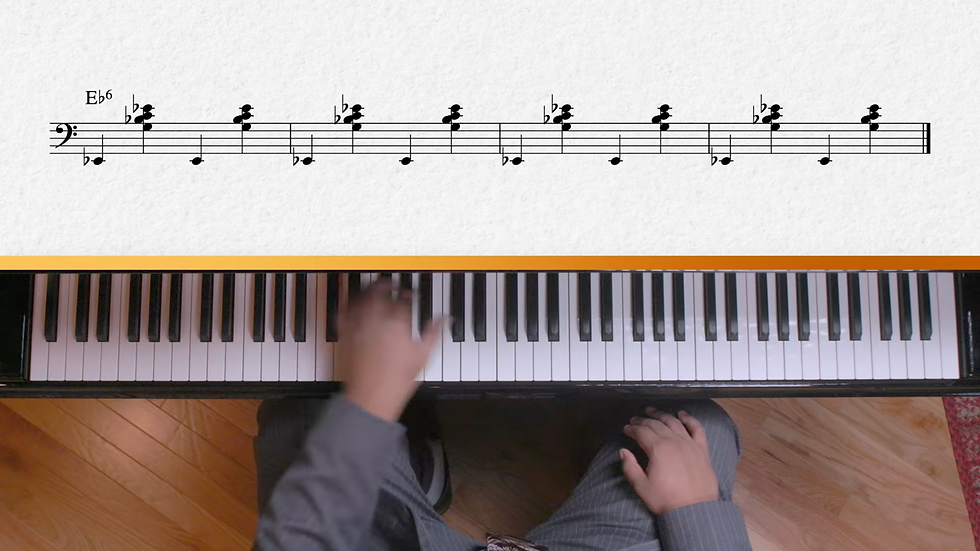
When you feel more comfortable, you can add in the tonic and V chords.

Syncopation and displacement
Another cool thing to do when playing stride in the left hand is using syncopation and displacement. An example of displacement is playing the root note and the five on the down beats, and then every other note on another beat. So here's an example.
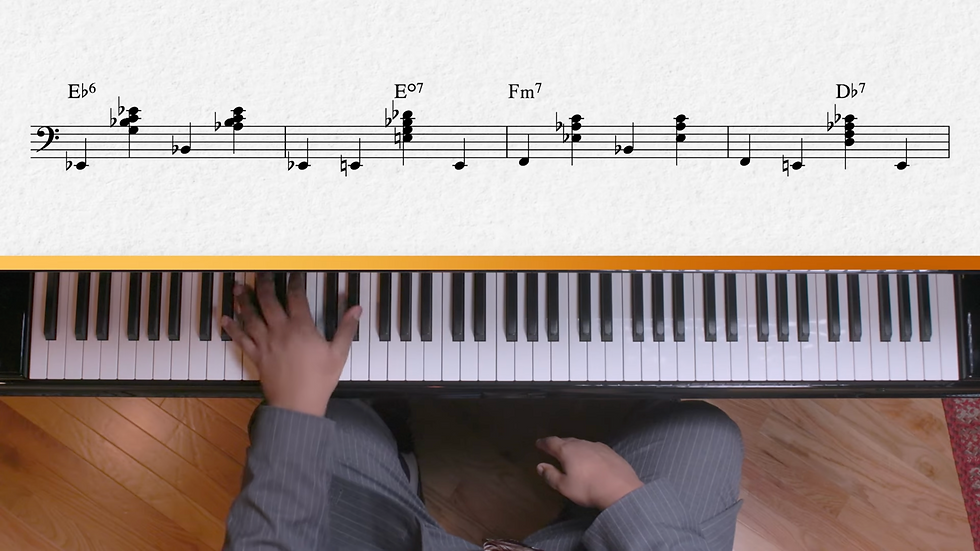
When you put it all together, it looks like this.

Right hand embellishments
Now let's move on to right hand embellishments. You can find examples of right hand embellishments in our etude on “Body and Soul.”

When it comes to embellishments in the right hand, something that William likes to do is play chords that are full. So when combining both the left hand and right hand, the first chord we play in the tune is Ebm, and you can add a 9 for more richness.

When playing or adding some syncopation, you want to be sure that your right hand sounds like a melody in its own right. In this way, you're able to have a steady left hand, and also a very lyrical and melodic right hand as well.
A good example when it comes to right hand embellishment is playing the melody, and embellishing it by adding certain ornamentations or riffs. Here's another example.

You can start by adding simpler phrases and also thinking about melodies in your head that correspond with the melody. But when it comes to embellishing it, you’ll make up your own melodies.

One important thing is to never be afraid of repeating yourself. Repetition is important in improvisation.
Left hand independence
Now we’ll look at left hand independence and walking bass variations. You can find examples of these in our Rhythm Changes etude.

When it comes to walking bass lines and left hand independence, your goal should be to think like a bass player. When you do that, it changes the way you think about how you walk, as well as the ideas that you play melodically.

You might want to make sure that you add some syncopation in there, along with a steady downbeat. When you add syncopation, it creates a sort of anticipation when you play. Here's an example with both hands.

Combining concepts
Finally, our last concept is putting it all together in complete etudes. We’ll go back to the etude on “Ain’t Misbehavin’.”

We'll start with the left hand “oompa” on the downbeat.

Adding the chord.

And then going on further with syncopation.

Adding in right hand embellishment, and then a bit of walking in the bass.

When you first start combining all these concepts together, it’s important to start off slowly, because if you start off too fast, it may sound sloppy or disjointed. It is said that slow and steady wins the race, and this is very true when it comes to stride piano.
That’s all we have for today, but if you want to see more of how William played the examples we covered, make sure to check out our accompanying YouTube video Stop Neglecting Stride: Accessible Techniques for Jazz Pianists (feat. William Hill III). And if you want to up your ability with playing stride, make sure to check out our resource 29 Stride Piano Etudes!
We’ll see you next time!


Mastering stride piano requires dedication and a solid grasp of foundational techniques. Similar to how one might analyze arcadegamebox.com/pt/games/kof-2002-magic-plus-2 to understand complex timing and patterns, music students benefit from breaking down difficult movements into manageable parts. Consistent practice is the key to developing the fluidity needed for advanced jazz performance. By focusing on these accessible steps, any pianist can improve their overall proficiency.