Practicing Altissimo the Musical Way (feat. Melissa Aldana)

Updated: Jan 27
One of the most challenging (and also misunderstood) parts of developing as a saxophone player, is the altissimo register.
Altissimo refers to the range of notes above the instrument’s standard written range, and this typically starts from high F or F#, depending on the horn. For a lot of players, altissimo feels unpredictable—tense and disconnected from the rest of the horn. But altissimo is not just about fingering or brute force. It's about voicings, air support, and embouchure control. When it is practiced musically, it becomes a natural extension of your range, not a special effect.
When you train your altissimo, it becomes reliable, expressive, and impressive in your improvised solos. One of the most important pieces of advice Melissa got about practicing altissimo, aside from learning the right fingering for it, was to realize that in order to make the altissimo feel like part of your horn, it’s important to practice everything that you know in all octaves.
So today we’re going to look at five core concepts to help you to develop control, confidence, and musical freedom in the upper register. All the examples we’ll look at today come from our resource, 25 Altissimo Etudes. Inside this resource, you will find 25 progressive etudes, designed to develop consistent altissimo control, smooth register transitions, strong intonation, and melodic fluency. All treating your playing like real music, not an exercise.
And if you want to hear how Melissa plays through any of today’s examples, make sure to check out our accompanying YouTube video, Practicing Altissimo the Musical Way (feat. Melissa Aldana). Now let’s get playing!
Contents
Altissimo control
Looking at the very end of our etude on “Moment’s Notice,” we’re playing from the middle register into the palm keys into the altissimo. And there are many ways to practice this, but advice that Melissa got from Mark Turner was to integrate them as another part of the horn—rather than a separate thing. And that was something that really helped her lose the fear of playing up there and learning how to play lines.

Another very important aspect to achieve this is the amount of control that you have in putting air into the horn. Your embouchure is one of the first mistakes that people make when they start practicing altissimo.

Your instinct is to put way too much pressure on your embouchure as you go up. This is natural, but it’s fighting you. The more relaxed you are, the easier it is to play higher on the saxophone.
Chromaticism in the altissimo range
Our next concept is chromaticism in the altissimo range, which is a really hard thing to do. An example is in the middle of the solo on our etude on “Along Came Betty”.

So on this Etude, we’re playing the bebop scale starting from G into the lower part of the register. Like we had said before, you want to practice everything you know in varying ranges, but especially the altissimo.
A great exercise is trying to play every bebop scale starting from the top.

And the more comfortable you get with your scales in the altissimo, you’ll be able to better hear these kinds of lines when you’re improvising.
Another aspect is the way that your fingers move. As Melissa was getting started with training her altissimo, she had to spend a lot of time (and still does!) playing very slow to make sure that every finger position is strategic.

So every time we’re playing a G, for example, we can be ready to play a high C or a high C#. So the more control that you have over your fingers and embouchure, the easier it is to achieve this kind of chromaticism when you're improvising.
Large intervallic licks
The third concept focuses on large intervallic licks, and we’ll look at the etude on “Recorda Me”.

One of the things that allows Melissa to play these kinds of voicings very clearly has to do with the way she practices. She practices by focusing on her sound every day.

And while practicing her sound, if she practiced the same thing every day, she wouldn’t address the things she needs to work on in her playing (because that changes). So every week, she changes the way she practices, and usually by focusing on voice leading. She found that since starting practicing that, it became easier to hear and execute lines while improvising. She also will think of time-feel and harmony.

So what we can do is think of a Dmaj7, and we can think of the 1, 7, 3, and 5. This lets us work on some larger intervals while working on our altissimo.
[insert]
Melodic shapes
Next, we’ll take a look at melodic shapes, with this example from the etude on “My Ideal.”

On this etude, there’s a phrase Melissa really likes from a Sonny Rollins transcription.

And now we’ll want to take this through as many keys and octaves as possible. The more we do this, the clearer and more articulate we can be in the altissimo.

Double-time lines
And finally, our last concept is double-time lines. This one is really tricky, and it's something that you may well be working forever. It's tricky because it requires a lot of control, and the most important thing is to make it feel easy. In order to make it feel easy, your fingers and embouchure need to be relaxed. Your whole body needs to be relaxed!
To play well in double time, you’ll need to be very conscious in how you move your fingers, and the best way to achieve this is by practicing very slowly. Let’s look at the etude on 26-2 on the bridge.
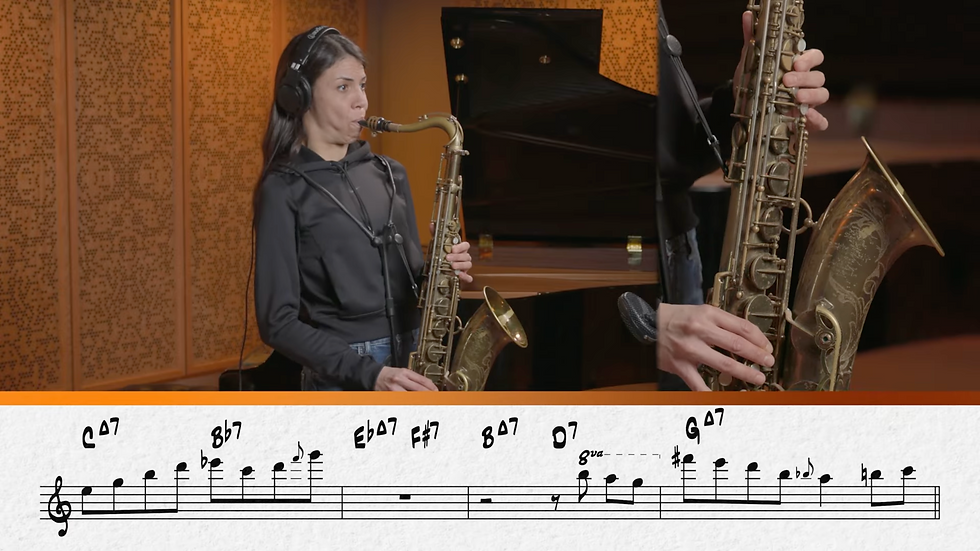
Melissa plays some lines over the ii-V going into C and then Eb. This is basically the bebop scale starting from altissimo G going down to the bottom of the horn.

Another way to practice altissimo double time is to not use your tongue and see how much control you have. Try practicing lines you already know, as well as bebop skills, major scales, etc.. And again, be sure to practice it very slowly.

Something else you can do is play in front of a mirror. When you’re playing fast, you need your fingers to be moving intentionally and predicting how they are going to move next. When you use a mirror, you can get a better look at how your fingers are positioned.
Well that’s all we have for today, but if you want to dive even deeper into this concept, make sure to check out our resource 25 Altissimo Etudes, as well as our accompanying YouTube video, Practicing Altissimo the Musical Way (feat. Melissa Aldana).
We’ll see you next time!


Comments