The Framework Every Improviser Needs (feat. Ryan Devlin)
- Jazz Lesson Videos

- Jun 2
- 4 min read
When it comes to our development as musicians, we're held back by fundamentals that we tend to neglect. Sure, we know all of our major scales, and we know which scales go with each chord, but when the chords start flying by, how do we actually apply that information? And if we're just running scales over chords, aren't we really just pressing buttons? How do we make that sound like music?
Often it's simply that we don't know how to approach the fundamentals in a practical, clear way, and our playing suffers because of it. That's what we’re going to look at today. We're going to cover some strategies to help you overcome these challenges, and everything that we're breaking down comes from our 30 Day Jazz Fundamentals course—a complete system designed to connect your technique and improvisation language in a structured, focused way. In this course, you'll find three lessons per day: a warm up, concept, and application, with applications of those concepts to jazz standards, a system that builds from technical and conceptual fundamentals into improvisational mastery, and all of these exercises are fully transcribed in PDF format, written in all 12 keys, and designed so that members can play along and practice with Ryan every day for the full 30 days.
Contents
Bebop scale exercises
We're going to be warming up with some bebop scale exercises. Bebop is very much arpeggios going up and scales going down, and when Ryan was first learning the Bebop scale, he learned this exercise to help implement it into his practicing, but also his solos. So, this is part arpeggio, part scale.
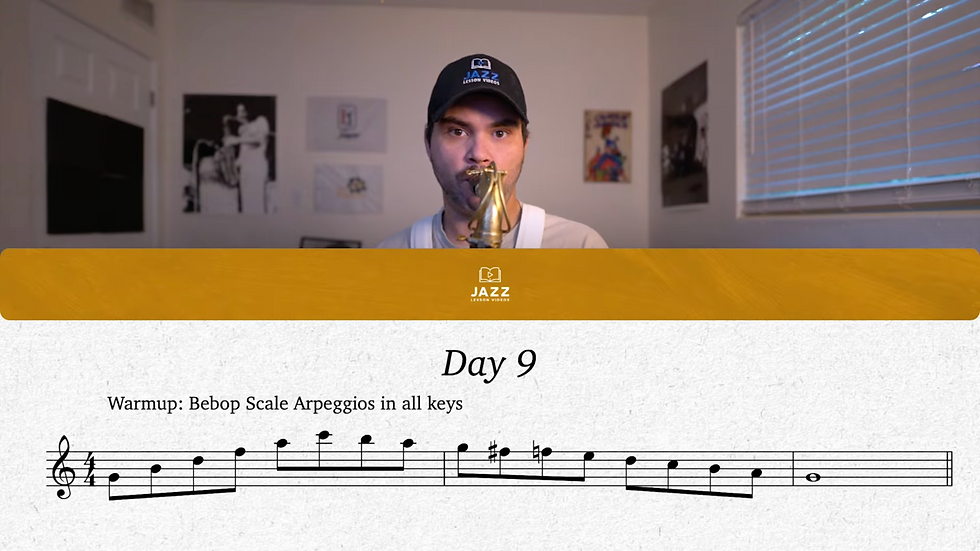
The Bebop scale is created using a passing tone between the dominant seven and the root. So we have a mixolydian scale, aka a dominant scale, G, A, B, C, D, E, F, G, but we're adding a passing tone of F#. You could also think about this as your major scale with a passing tone between the 6 and the 7—G, A, B, C, D, E, F, F#, G.
So we're taking that scale and playing an arpeggio off the root up to the 11th degree, G, B, D, F, A, C, and then play the scale going down. We'll do this one in all 12 keys, this time going in the circle of fourths, so check out the PDF if you want to read along.

Adding approach tones and enclosures
Our next concept today is going to be adding chromaticism, like approach tones and enclosures, to a diatonic ii-V-I phrase. So we're going to take a standard ii-V-I phrase with just chord tones, and then we're going to add some approach tones and enclosures to it. Here is our diatonic phrase.

You'll notice we’re using some 9s as chord tones. You can consider 9 an optional chord tone 1, 3, 5, 7, 9 is how most piano players will voice things, having the 9 in there. So, you'll notice that now what we're going to do is we're going to add some enclosures to this line to spice it up and give a little bit more of that melodic voice leading bebop sound. Check it out.

As you can see here, we're adding some of these non-chord tones to voice-lead us better to our chord tones. So, for example, on D minor, we play down the arpeggio from the V, and in the diatonic example, we play C and A, C and A to get us to B natural of our V chord, but in the chromatic example with enclosures and approach tones, we play down the arpeggio, but then play a non-chord tone, C#, back down to A, then to C, A, B.
So we create an enclosure with one non-chord tone with C#, but then enclosing the third of the V chord, B natural. This adds that one non-diatonic note for some chromatic tension, which leads us even stronger to our V chord, where we're landing on a chord tone, our 3.
Back in the diatonic example, we go up an arpeggio from the 3 of our dominant chord, up to the root, and in the diatonic example, we just play the 9—A, G, F, E, C, to get to our tonic chord.
But in the non-diatonic example, where we’re adding approach tones and enclosures, we create an enclosure, with Ab and Bb, the b9 and #9 of our V chord, and then that leads us to the root, G, F, E, C, where we resolve to the tonic chord.
Applying concepts to Autumn Leaves
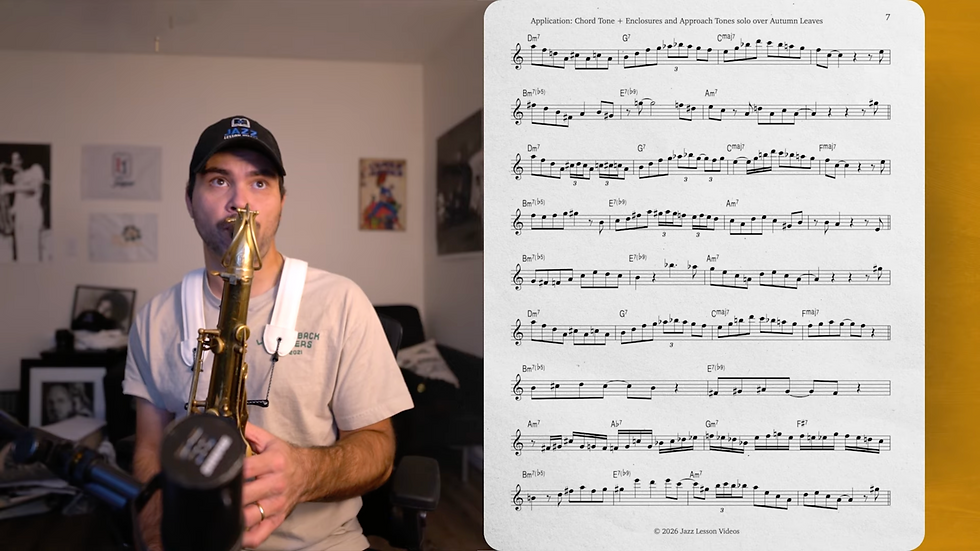
Now for our application process of putting this on a tune, we're going to take “Autumn Leaves,” and we're going to take the first major ii-V in Autumn Leaves and insert our ii-V-I line from our exercise block. Every time we see that ii-V-I progression, we're going to insert that line. Everything else is going to be improvised.
If we want to add even more chromaticism and enclosures into our solo or etude, here we can add approach tones to other ii-V-I phrases or other chord progressions, like on our half diminished chord.
We're going to focus on playing our ii-V-I line from our exercise and apply it to Autumn Leaves. Every other progression in this tune is just freely improvised over.
But the main focus should be playing this line and applying it to Autumn Leaves. So major ii-V to concert Bb, we're going to insert our line. Everything else is going to be improvised.
That’s all we have for today, but if you want to dive even deeper on things like these, make sure to check out our 30 Day Jazz Fundamentals course. And if you want to hear how Ryan played through anything we talked about today, check out our accompanying YouTube video, The Framework Every Improviser Needs (feat. Ryan Devlin).
See you next time!


Comments