Instant Chord Recognition Training (feat. Luther S. Allison)

While we often think of musicianship as how well you can play, today we’re going to look at one of the most overlooked but absolutely essential skills in music, and that's ear training. No matter what instruments you play, your ears are the gateway between theory and real music. You can know your scales, your chords, your fingerings, but if you can't hear what's happening, it's hard to react, improvise, or truly internalize the music.
We're going to explore some ear training skills that every musician needs, organized into a practical step by step system designed to strengthen your ears. Every example you'll hear today comes directly from our resource 30 Day Ear Training Boot Camp. In this course, you'll find core ear training skills integrated throughout pitch identification, melodic dictation, scale and phrase identification, chord identification, and chord progression identification. Also make sure to check out our accompanying YouTube video, Instant Chord Recognition Training (feat. Luther S. Allison), because we have a few quizzes for you to test your skills.
Now let’s get playing!
Contents
Pitch identification
Let's start with our first concept, pitch identification. Today, we're going to discuss hearing some of the upper structures and some of the alterations within the upper structures of a dominant seventh chord.
So we're going to stay within the key of C. We're not going to leave for now, but obviously take all of these things on your own time. Go through each of the keys—do it in A, do it in G, do it in E. Do it in the uncomfortable keys that you don't play in as often, like maybe B. This is going to build muscle memory, and it's going to help you be comfortable playing this when the time comes.

Here's our C dominant seventh chord. Our basic extensions are the 9, 11, and 13, which are the 2, 4, and 6, respectively up the octave. Let’s start by playing the 9 and getting it in our ear. The 9 is very close to the root, and feels a bit like it’s floating on top of the root.
A really cool exercise we can do is play each of these pitches, hold them, and then take off the top pitch and you sing it. Then try taking one more off and sing both of the missing pitches. It’s important to remember you don't have to have perfect pitch to be able to hear this. You want to train your ear to become familiar with these sounds. And you will definitely make mistakes, but frequent repetition is how you can get it to become part of you.
If you can, try to get the chord down all the way to the root. If you can sing the chord from bottom up, you’ve got it! Being able to do this through the keys is a big process, but it will really help develop your ear.

Now, just dealing with this 9, what if we flat the 9? Start by playing the 9 and then move it down a half step, and then up a half step. This way you can hear how it sits in relation to the 9.
Now do the same thing on the 11. We can move the 11 up a half step. Now we have our #11. And as you do these alterations, as you play them, maybe even try singing the alteration along with the chord. Play the whole chord again afterwards. So now you can hear the context of the altered note in the entire chord.
Now at our 13, we're going to keep the #11. And as we move that down a half step, we have a little bit of a cluster here, but it's kind of hip. There are ways that you can voice these chords differently, so it sounds a little bit cooler.
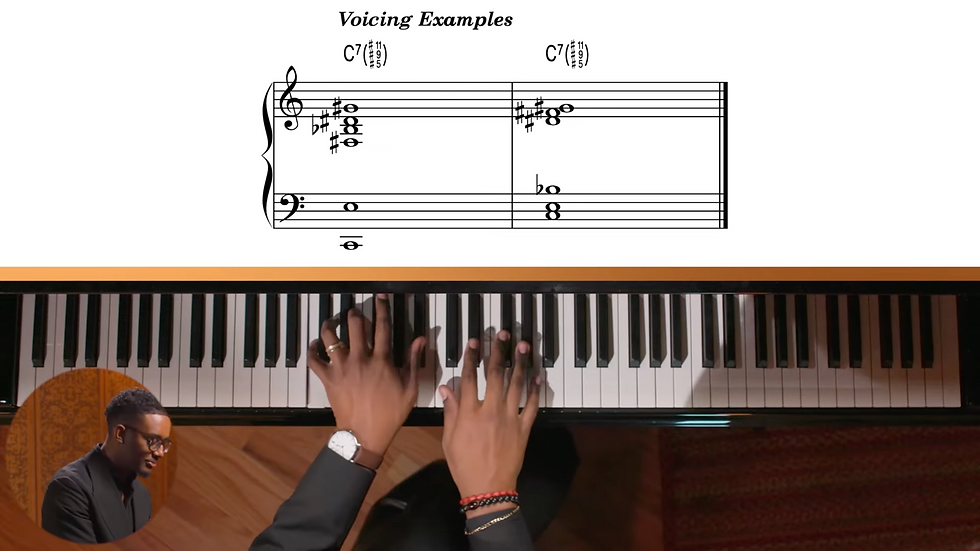
Let’s try and alter all of them. That gives us #9, #11, and b13. We can’t have a b11 because that’s the major 3 and we can’t have a #13 because that’s our b7. Now try to take all of these ideas through the keys—play the chord, sing the altered note, and try to pick each note out, one at a time with each of these alterations.
Now you’re ready for a test. Check out our accompanying YouTube video to see how many you can get! (Test 1 starts at 6:15).
Suspended chords
Now let’s discuss suspended chords or sus chords. Sus chords are very unique because they're pretty closely related to our extended dominant chords.
Your sus voicing is typically not going to have the 3 in there. To replace that, your 3 is going up a half step to your 4 (the 11). Now we have our regular suspended sound, 1, 4, 5, b7.
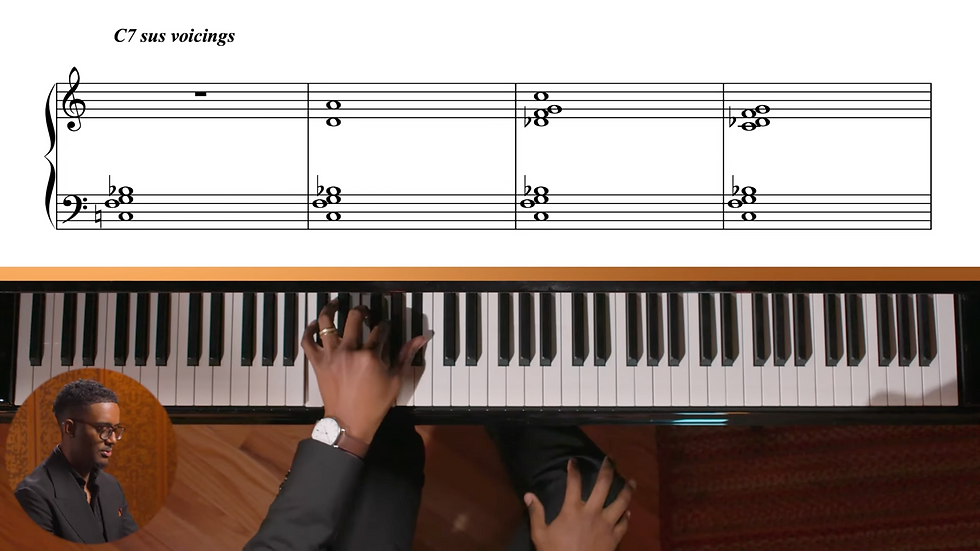
We’re generally going to call this the 4 instead of the 11, however, because it’s from the 3 going up.
You can also fill this out some more—with the 9 and 13. Herbie Hancock's Maiden Voyage is a perfect example of a tune that uses a lot of suspended chords. A lot of music uses this sort of a sound, though. Our only difference, we're adding our 9 and our 13. By this point, we should be fairly familiar with how to hear that 9 and that 13.

Another beautiful sound that we can get from here is going to be our susb9. It has a little bit more of a spooky sound, but it's very soulful, too. Closely related to this chord, we can also have our susb13.
Think you’re ready for another test? Check back on our video and see if you can identify these chords. (Test 2 starts at 10:15).
Well that’s all we have for today, but ear training is not a one-off thing. It is a process—one that takes time and needs to be practiced. And if you’re looking for a way to really grow your ear, make sure to check out our course, 30-Day Ear Training Bootcamp. And if you want to hear how Luther plays through anything we talked about today (especially our tests), make sure to check out our accompanying YouTube video, Instant Chord Recognition Training (feat. Luther S. Allison).
We’ll see you next time!


Comments