Stop Being Bland on the Blues… Shed This (feat. Bruce Harris)
- Jazz Lesson Videos

- Apr 13
- 7 min read
There’s a difference between just playing the blues and making your solos touch people. It's not just about it sounding correct, not about just outlining the changes, but you want it to feel honest, personal and alive. For Bruce, the blues isn't just about the scales or the form. It's a testimony. It's a reflection of how you feel, whether that feeling is joy, sorrow, humor or resilience.
The blues comes to us through African traditions and through the lived experience of African Americans—shaped by pain, separation, struggle and the realities of oppression. But out of that came resilience, the ability to take that experience, shape it with intention, and then transform it into something powerful, expressive and long lasting, just like the blues. That spirit, that voice, is still the foundation of everything we play.
That's why the blues feels connected to singing. We always have to sing through our instruments. If there's no voice behind what you're playing, then even the right notes can just feel wrong.
A lot of players know the form. A lot of players know the changes. They know what scales work, but somehow the solo still just isn't hitting. Nothing is wrong with that, but nothing is really reaching, either. When you shift the focus from information to shape, rhythm, space and intention, the music starts to come alive.
Today, let’s look at some targeted etudes from our resource called 25 Blues Etudes. In this resource, you'll find a wide range of examples over the blues, covering approach tones, enclosures, double-time lines, rhythmic development, the blues scale, harmonic substitutions and ways to combine them all.
And if you want to see how Bruce plays through anything we talk about today, make sure to check out our accompanying YouTube video, Stop Being Bland on the Blues… Shed This (feat. Bruce Harris).
Now let’s get playing!
Contents
Inflection
Let’s talk about adding inflection to your playing, or like we said earlier—singing through your instrument.
When we play lines, obviously hitting the right chord tones and playing the right licks are certainly of high importance, but we need to make it come to life. We should aim to make that line sing as much as possible.

In our Bb blues etude, there are a couple of lines that for Bruce, have come over the course of time studying the great masters of the trumpet—Clifford Brown, Lee Morgan, Freddie Hubbard, and some lesser known players, for example, like a player named Johnny Coles. If you haven't checked out Johnny Coles, check out Johnny Coles.
And so Johnny Coles will play a line, and he adds a certain essence to when he plays a line. So if we would play something like this…

Johnny Coles would take that phrase, which is a beautiful, melodic phrase, and treat it something like this.

So when you add the vibrato to it, you add the slides, the half valve—that's a singing quality, that's a quality that might sound similar to hearing a gospel singer or an RnB singer. It's really about taking all of these lines and phrases and adding your personality to it. Now, over the years, Bruce has transcribed all of these players and compiled all of this information, and over time, the more you do it, it becomes you—because the one thing we all have is personality. Whether it's an upbeat personality or maybe you're just kind of chill, mellow or maybe you're super hyper, you want to put who you are into the instrument. Once we take chord tones, lines, licks, and patterns, the final touch is just really putting you into it.
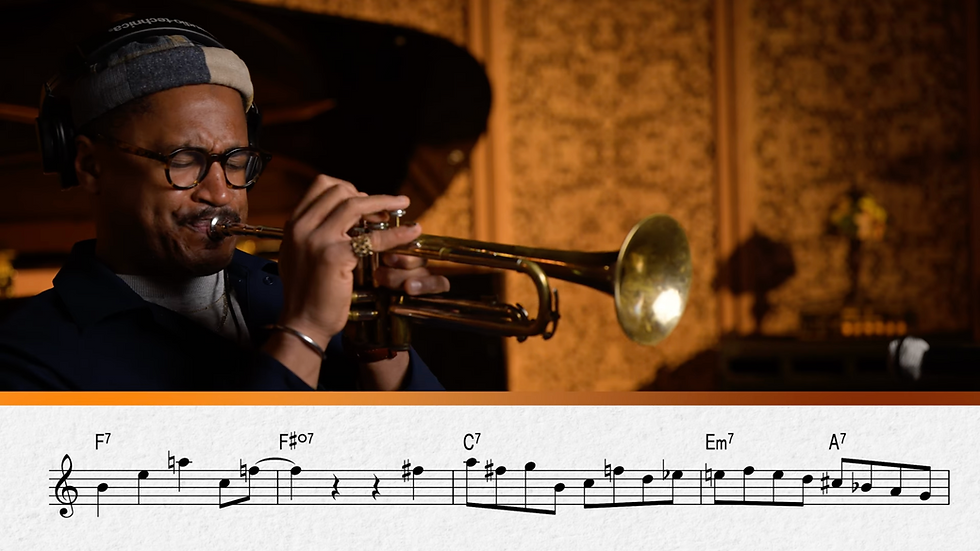
We can take that line and play it straight.

There are some great notes in there, right? But now we have to add the flavor to it. We got to add the style, the personality, whatever that means to you.
Double-time lines
On to concept number two—one that we all love, and that’s double-time lines.
[insert]
Looking at the lines in our etude over Mack the Knife, there's a phrase in there that you might have heard before. It's one of Bruce’s favorite double-time phrases.
This phrase comes from the Dizzy Gillespie composition entitled Emanon, and it goes a little something like this.
[insert]
Learning lines from the masters is absolutely essential, because not only are you learning the notes, but you're learning all the inflection that goes along with it.
Within your double-time lines, it's not just about playing fast 8th notes or 16th notes. It's also about adding the accents when you play it as well. So if you take this:

And want to give it a little extra sauce, try putting a little accent on it.

Another important part of building double-time lines—you must take all of your phrases and play them with a metronome and speed them up over time, because if you can play it slow, you can play it fast. It's all about precision.To play things fast, let's play them correctly, and make sure that we play with good time. And so using the metronome to go through some of these phrases and then gradually speeding up will get you to that place you want to be to be able to play things much faster.
Approach tones and enclosures
This next concept is approach tones and enclosures, and you can find this in our etude over Freight Train.
Thinking in terms of approach notes and enclosures, we might not necessarily think about them in such a technical way. We want to hear these things musically, so where our ears know to go to it.

If you go back and listen to interviews by Dizzy and Miles Davis, they sometimes talk about a concept that “there is no wrong note.” What does that mean? Well when you think about that, approach notes and enclosures highlight what that means.
For example, let's say the note we want over a C7 is C right? But what if we play a note a half step above and a half step below?

Now, technically … those aren't the right notes for a C7. But it's all about where we’re going.
For example, if we want that B flat and we want that E flat, but we play a half step above and a half step below, let's see what that sounds like for those two notes.

It's all about going for the note you want, not necessarily hitting it right on target. Let's say we want to play a melodic phrase that goes something like this.

If I want to add enclosures to it, it might sound something like this.

You see what we did there? Above, below, target … above, below, target. We can also think of shapes. Like when we’re seeing these lines, we know the direction we want to go is straight ahead, but we want to make some zigs and some zags. We’ll go up, down, a bit to the left, a bit to the right. It's all about the shape. That's a very organic, musical way of thinking about it.
It’s easy to fall into asking “what does that note mean? And what does that note mean?” Let's try to see it and visualize it. Let's try to paint a picture with what we're doing, and then we can go back later and analyze it.
Ultimately, the melody is what we’re thinking about. And then those approach tones and enclosures are just one way to zig when you want to zag, or zag when you want to zig.
Looking at this:

A lot of that, even though approach tones and enclosures are a thing, it's really about creativity. Be creative.
Bruce has learned a lot of solos from the master trumpet players and from playing them over the years. You start to know them, and then eventually you forget them. And what Bruce likes to call it is remixing the solo. So we'll play a solo that will be kind of similar to a Clifford Brown solo, but over the years, it’s reworked itself in our head.
Rhythmic development and storytelling
The next concept we're going to talk about is rhythmic development and storytelling.
Now, what does that mean? We all play the same notes. We all play the same chords. So how do we make what we're doing different from what has already happened or what is coming up?
Rhythm is the key element of originality in terms of what you're doing. So a lot of times, if Bruce is playing a blues, he wants what he’s doing to be a little bit like telling a story, that it’s conversational. If we’re playing a Bb blues, we might do something like this.

The rhythm and the space paired with how we pace our phrasing is what makes it come out like a story.

Then if we change up the rhythm and the inflection, we’re telling that story in a different way.
The Blues scale
We’ve all heard of this one. So how is it that we all play the blues scale, but yet it comes out so differently from one player to the next?
For Bruce, when he thinks of a scale, he looks at it as a melody. Now going back to that idea of singing, if you didn't play an instrument, you’d have to sing that melody or sing that scale. We want to look at it as a melody.
When you sing, (hopefully) you want to sing with feeling! Even if we were to take that blues scale, straight ahead as we all know it…

We really want to sing that.

So again, it's about remixing a melody, remixing a scale and making it vocal.
When we take that blues scale, let's think of what kind of song we can make with that scale—like, what can we do, from an inflection standpoint, to make it hip and make it really touch people?
Let’s take the shape of a few notes from the blues scale, play it straight first, and then we're going to make it sing.

When you put that kind of feeling, that kind of phrasing and that energy into what you play. It's not a scale anymore, but if you don't do that, then you're just playing a scale.

Well that’s all we have for today, but if you want to dive even deeper, make sure to check out our 25 Etudes on the Blues resource, along with our accompanying YouTube video Stop Being Bland on the Blues… Shed This (feat. Bruce Harris).
We’ll see you next time!


Comments