The BLUEPRINT to Bebop (feat. Cecil Alexander)

The idea of where to start when it comes to bebop can be daunting. Today, we’re going to look at a clearly structured blueprint for developing real jazz vocabulary and stronger improvised solos. Our new course, 30 Day Jazz Vocabulary Bootcamp, provides a clear day-by-day practice plan where every session focuses on three key elements: a technical warm-up, a vocabulary concept, and direct application to a progression or tune. The course also includes downloadable notation exercises, detailed video demonstrations, and practice concepts organized in all 12 keys. By the end of the 30 days, you'll have developed a deeper jazz vocabulary and a clearer system for building lines, giving you practical tools you can use to improvise more confidently over real jazz harmony.
Now let’s get playing!
Contents
Dominant bebop scale patterns
Today, we're going to be talking about the use of the dominant bebop scale. The dominant bebop scale is very similar to the major bebop scale in the way we're going to apply it. You still want to think about descending lines from all 12 chromatic notes because that's just going to give you fluidity with the scale. So we'll do the G dominant bebop scale—our chord tones are just going to be G, B, D, and F. So play descending lines through one octave each for those.

Once you’ve done that, you’ll want to try playing in different registers and octaves and everything, too.

Then on to non-chord tones—so those are going to be the 9, 11, and the 13. From the ninth, we have a chromatic approach into the root. From the 11, just like the major bebop scale with an enclosure. And then from the 13th.


And then with the dominant bebop scale, you also have arpeggios available. We have arpeggios that are built off of each chord tone: G7 off the root, Bm7b5 off the 3, Dm7 off the 5, and then Fmaj7 off the b7.

You can also create longer lines that are combining the arpeggio with the scale. So if we go up G7, land on E (the 6) and then add a chromatic approach to get to D, we go down the scale to B, then go up Bm7b5, and go up Dm7, up Fmaj7, and then you can do that in different octaves and for as long as you want.

Using bebop vocabulary over ii-V-I progressions
Let's check out using some more decorative bebop vocabulary over two five ones. There are a couple things that you can add to the bebop scale to make it sound more idiomatic.
One is going to be the use of pivot arpeggios and pivot arpeggios with rhythmic decoration. So if we take those arpeggios that we did in the first part, you can create pivot arpeggios.

It’s basically a form of octave displacement. We're going to take the four-note arpeggio and lower the top three notes down one octave. So if we have G7, we’re going to lower B, D, and F down one octave.

And then one step further, you can add in rhythmic variation to that, like adding in a chromatic before the second note, and then the remaining three notes as an eighth note triplet. Same thing with the other arpeggios.
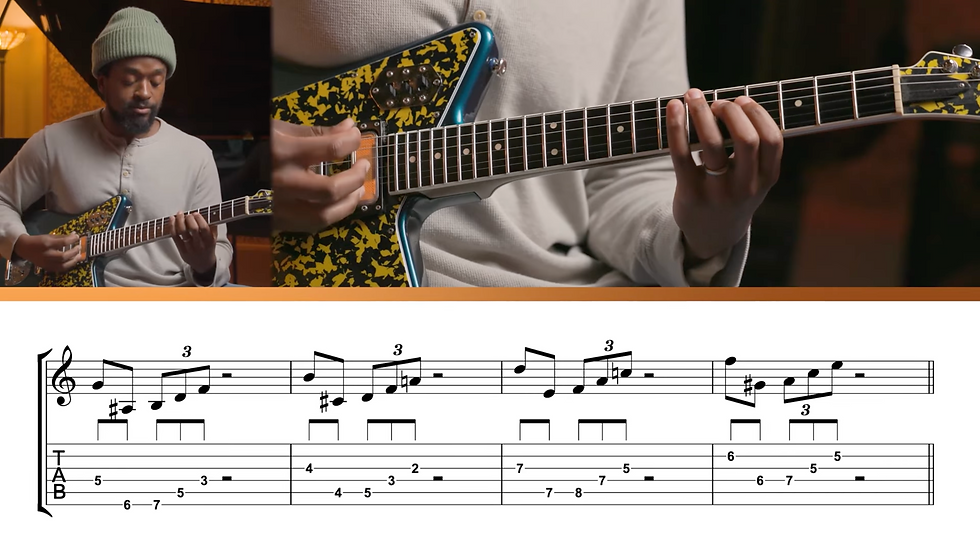
Another thing that you can do with bebop scales is take some of your favorite licks and put them in the context of the scale. So this is kind of combining two foundational pieces of bebop vocabulary. We have this approach within the scale diatonically, and then 5, b3, 2, 1.

So the melodic cell, and if we combine that with the G dominant bebop scale, we’re playing the lick, landing on the 4, resolving to the 3, and then going down the scale. And we could extend the rest of the phrase however we want.

As we go to F and do that pivot arpeggio with the rhythmic variation, we then go down the scale from there. And this is especially useful for voice leading when you're going from one chord to the next. It gives you more ways of filling up the space that sound stylistically appropriate.
Now we're going to check out the application of bebop language using the dominant bebop scale and major bebop scale over the tune "Take the A Train.”


Well that’s all we have for today, but if you want to dive even deeper on these concepts and more, make sure to check out our new course, 30 Day Jazz Vocabulary Bootcamp. Plus if you want to hear how Cecil plays through anything we covered today, make sure to check out our accompanying YouTube video “The BLUEPRINT to Bebop (feat. Cecil Alexander)”.
We’ll see you next time!


Comments