Stop Running Scales… Learn Real Vocabulary (feat. Kellin Hanas)

Today we're going to be discussing some methods to help you build better jazz language. We're going to talk about ways to build better jazz vocabulary through concepts like major/minor ii-V-I language, motivic development, rhythmically displacing your lines with syncopation and starting your ideas off the beat, and expanding your vocabulary with modern techniques such as substitutions and pentatonics.
All of this comes from our new course, Jazz Vocabulary Builder, which you're welcome to check out if you want to dive deeper into any of these concepts. And if you want to see how Kellin plays through anything we talk about today, make sure to check out our accompanying YouTube video Stop Running Scales… Learn Real Vocabulary (feat. Kellin Hanas).
Now let’s get playing!
Contents
Major ii-V language
Let’s talk about major ii-V-I progressions. They're everywhere and they're in basically every jazz standard. The quicker you learn how to play over ii-V-I progressions and clearly outline them, the quicker you'll be on the path to playing any tune you want. And just in case you don't know about this progression, it's exactly what it sounds like. It starts on the minor ii chord, moves to the V dominant chord, and ends on the tonic major chord.

So we can see in this first measure on beat four, we're starting on the five. We're moving diatonically up, so we can get to the 3 of the next bar, which is F7, so we go 3, 2, 1, 7, all the way down to the 3 of the next measure, which is this Bbmaj7. So we're hitting the 3, we're kind of doing an arpeggio up to the 9, then we hit the 1, and here at the end of this third bar, we're using an enclosure to target this D on the downbeat of the fourth measure, which is the 3 of the chord, and we're doing that by using an Eb and a C# to enclose that D natural.

And this next line here, we're playing very diatonically in the first measure. Then when we get to the second measure, we start on that b9, we move down, we pretty much play an F triad up, and then in the third bar, when we get to that Bbmaj7, we use an enclosure, but we actually kind of rhythmically displace it instead of putting it on the one or on the two. We put it on the “and” of one, and then we leave another eighth note rest in between the first note and the second note of that enclosure. So we're enclosing this Bb with a B natural and an A natural. Then we move down, we hit the five, we hit the four, one, and then in that fourth measure to end the line, we play a triad up until we hit the flat nine of the next chord.

In this next line, we're again playing pretty diatonically. We're pretty much playing the chord tones. We start on the 5, we go to the 7, down to the 5, back to the 3. We do a little turn around, like a little triplet, to get us all the way down to the 7, which is that Bb, and then in the next measure, the second measure, we're really heavily implying that tritone substitution sound over that F7. So instead of playing that F7 sound, we're instead playing and implying a B major sound over that chord. Going into the third measure, we're kind of anticipating the 3 of that one chord, half a beat early, so we play it on the “and” of four, and then we go into again a very diatonic pattern, and we kind of play a little bluesy line at the end, utilizing that b3.
Minor ii-V language
Equally as important as the major ii-V-I progressions, the minor iiº-V-i progressions is also heavily used in a lot of jazz standards. This progression starts on the half diminished ii chord, moves to the V7b9, and then to the i chord.

So we're starting on the 7 in this phrase, and we're moving up to the b9 of the chord, and then we're using an approach tone line to move to the b13 of the next chord, and then we play up chromatically, and we resolve to the root of our V7 chord.

Then on the tonic chord, we play the melodic minor scale of C. In this line, we start on beat four, automatically moving down chromatically to get to that 5 of our V7 chord. And on the V chord, we're playing what's called the Phrygian dominant scale. And then in bars three and four, we're using that C melodic minor sound.
Motivic development
Just like rhythmic development, motivic development helps you extend your ideas and create a theme throughout your solo. But this time, instead of just playing with the rhythm, you're finding ways to take a short melody that you may play in your solo and find ways to play with it. Maybe you play an idea, move it up a half step, leave it, and come back to it at the end of your solo. Maybe you play the idea over and over again until the final time when you extend upon it to create a new line. In your own practice, you can try blowing over a standard, and if you hear a melodic idea that you like, try to play it a few times, move it away from it, and then see if you can remember it and play it again at the end of your solo.


Rhythmic displacement
Rhythmic displacement is crucial for creating rhythmically interesting ideas. You can use it not just when you're soloing, but you can use it to play around with the phrasing of melodies as well. For example, if you play an idea that you like on beat one, maybe you'll follow it up with a version of the same idea, but starting on a different beat, like the “and” of one or beat two. This can also help us play melodies less like we're reading it from a lead sheet.

So, for example, with All the Things You Are, first we're going to play the melody super straight, exactly how you'd see it on a lead sheet, and then we're going to take the melody and we're going to kind of displace the rhythms a little bit and change the phrasing around so that it's less lead sheet-like. And then we're going to play a solo over it where we play ideas that aren't right on the downbeat, but a lot of syncopation is involved, a lot of starting ideas on the upbeats.

Intervallic vocabulary
Using intervals is another great way to give your solos an engaging sound. It allows you to create ideas that don't just sound like you're playing scales or lines, and it allows you to be more creative. Some important intervals to learn are playing in fourths and fifths. So here's some exercises that you can do to train your fingers. The first two exercises deal with intervals of fourths. So it's basically just going up by fourths and then going down by fourths.


The other two exercises are going up and down by fifths.
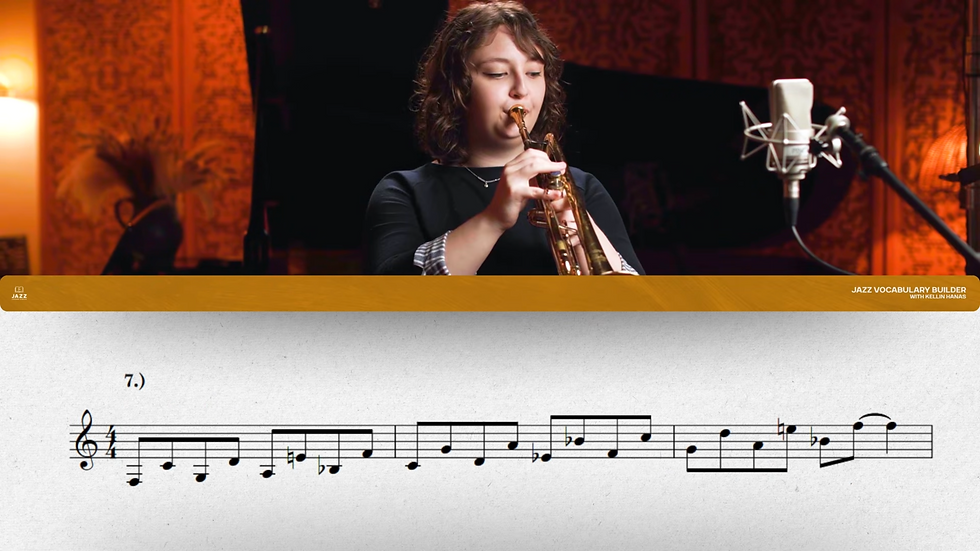

Another exercise we really like to do is one of Laurie Frink's exercises that really utilizes going up by a fourth and going down by a fourth.


Pentatonic vocabulary
Pentatonic language is another type of language that's widely used by your favorite musicians. You might even be using it and just not know the name of it yet. This kind of language comes from the pentatonic scale. The major pentatonic scale uses the 1, 2, 3, 5, and 6, and the minor scale uses the 1, b3, 4, 5 and b7.

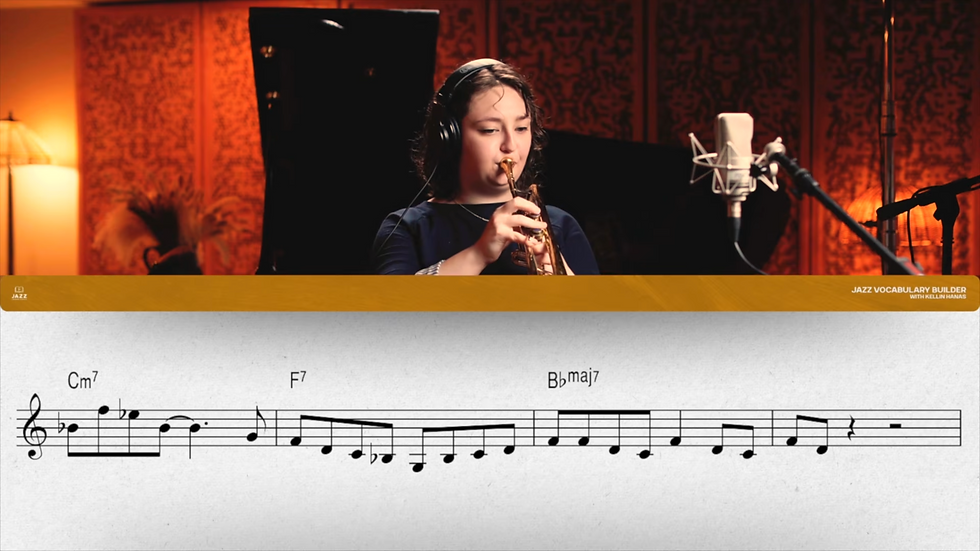

You can play major pentatonic language over major ii-V-I progressions and major vamps, and the minor pentatonic sound over minor chord progressions. Another thing we like to do with pentatonics is shift them away from the main key center that we're in to create some tension and release. Let’s look at using our concert Bb major pentatonic, and we'll shift it up a minor third to the concert Dbm pentatonic. This adds some really cool tension into the sound, and then it releases when we go back to playing diatonically.


Well that’s all we have for today, but if you enjoyed this, you may want to check out our Jazz Vocabulary Builder course for more. And if you want to hear how Kellin plays through anything we talked about today, make sure to check out our accompanying YouTube video Stop Running Scales… Learn Real Vocabulary (feat. Kellin Hanas).
We’ll see you next time!


Comments