The Secret Methods Behind Burning Bebop Lines (feat. Cecil Alexander)

Today we’re going to look at something that really separates intermediate players from advanced improvisers: confident, fast bebop language.
At a higher level, jazz improvisation isn't just about knowing scales or running patterns. It's about how you outline harmony with precision, and how you create forward motion and tension and release. Bebop language is detailed, intentional, and rhythmically alive. It's not random lines. It's controlled melodic architecture.
We're going to look at how to connect changes with clarity, how to use chromaticism in a musical way, and how to build lines that sound authentic and idiomatic—the kind of vocabulary you hear from players like Charlie Parker, Bud Powell, and the entire bebop tradition.
All of the topics that we get into today come from our new resource 75 Burning Bebop Lines. Inside, you'll find 75 original bebop lines designed to develop strong voice leading, rhythmic phrasing, chromatic control, and harmonic accuracy, all written over real progressions you'll encounter on standards.
And if you want to follow along with any of the examples that we talk about today, make sure to check out our accompanying YouTube The Secret Methods Behind Burning Bebop Lines (feat. Cecil Alexander).
Now let’s get playing!
Contents
Approach notes and enclosures
So let's start with concept one: approach notes and enclosures. To start, we're going to take a look at using enclosures in context with this phrase over a minor ii-V-i.
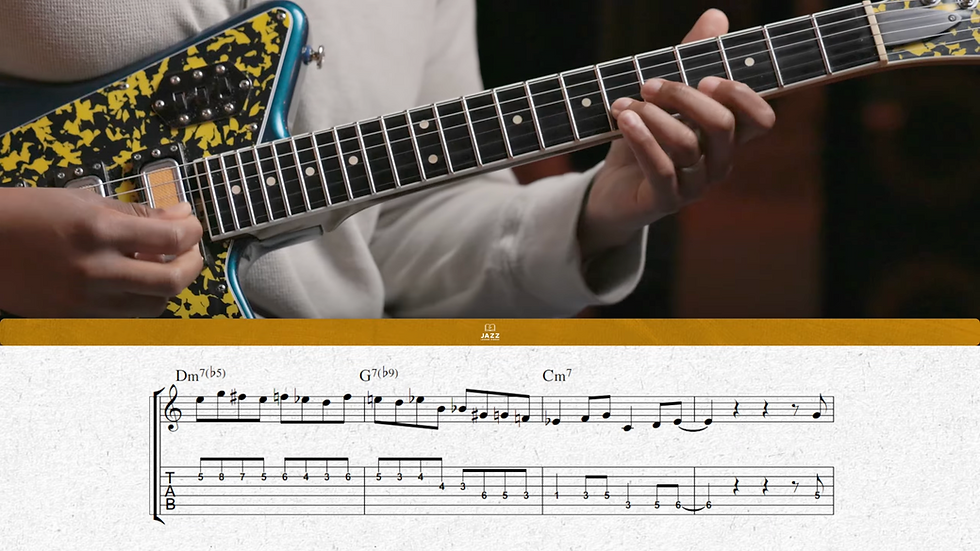
We start off with an enclosure to the b3 of Dm7b5. We're going to be approaching our target from a step below and a whole step above and we kind of vary the directions in there, to create more melodic interest.
So starting on that E, up to G, down a half step to F#, and then back down a half step below our target E, finally hitting F on beat 3, just down the scale from there, and then we target E natural on G7b9. We do another enclosure to get to the b13, and then we have this classic altered sort of scale phrase ending. So that's targeting that #9 there, then getting to the b3 of Cm7, and just doing a quick scalar sequence here.
For our next phrase, we're going to take a look at the use of approach notes in context. So this is just going to be approaching a target from a half step above or half step below, but it could also just be diatonic steps. You can have diatonic approaches the same way that you have diatonic enclosures.

In this first phrase, we start by targeting the b7 of Dm7, which is our ii7 in this ii-V progression, and then we target the 5 of that Dm7 from a whole step above, then we target the 4 using another chromatic approach, and just down the scale to E on G7. Then we target the 5 using another whole step above chromatic approach from that D, just going down the scale, and then we have this approach into the 5, which is a little like a slight harmonic anticipation, just anticipating that Cmaj7 by one eighth note.
Rhythmic variation
Concept two is rhythmic variation. We're going to see an example of this over a major ii-V-I in the key of C major.

We’ll start off with some syncopation. We have a rest on beat one, an approach into the 9 of Dm7, and then we have the 4 on an upbeat one, and then a diatonic enclosure into the b7 of G7, and then we have this pivot arpeggio that has a little rhythmic variation in it.
So we have an Fmaj7 pivot arpeggio with a chromatic approach before the second note, and the remaining three notes as part of an eighth note triplet. That's a really common bebop shape that you'll see a lot.
We hit the b13 of that G7, and then we do this little chromatic enclosure into B, which is in anticipation of the Cmaj7 that's about to come, and then we grab the 3 of Cmaj7, and then we have this little turn within the scale, which is a great way to create rhythmic variation. You'll see that like in the first phrase of the melody of Donna Lee
So this little rhythmic turn is very simple to think about and put into context. Then we finish with this little melodic cell within the scale.
Harmonic embellishment
The next concept is harmonic embellishment, and with this phrase we're going to take a look at playing some different colors on the chord.

We have a major ii-V-I and we're going to start off with this little rhythmic variation, a turn within the scale to get into the 9 degree of Dm7, up to the b3, just using the scale, and then we have a pivot arpeggio again, this Fmaj7. Again, a really useful way of creating movement in eighth note bebop lines. Then we're creating the sound of Db7 here with a tritone substitute. So G7, you have your b7 and your 3. Those two notes are shared by a dominant seventh chord up a tritone, which is Db7. This gives us a really clear outline of that with some chromaticism, and then we resolve into the 5 of Cmaj7. Then we have intervallic leaps in here to embellish the sound of the tonic chord.
When you're playing over ii-V-I, a really common thing is to generate a lot of tension over the V chord, but we can kind of keep that tension going over the Imaj7 chord with things like Lydian or Lydian augmented, incorporating the sharp five there.
So we just go up a G major triad, and then we have these leaps that are shifting directions and the intervallic distance is getting smaller, so the distance of a sixth, and then the distance of a fourth is a great way to play with the listener's ears. You know, you could extend the phrase like that if you wanted to.
Essential blues language
The fourth concept is essential blues language. So the blues scale and blues vocabulary are really great ways of shaking things up in a solo.
When you think about the prominent soloists in bebop, like Charlie Parker, Bud Powell, Dizzy Gillespie, and even Sonny Rollins, they always had this blend of you know the key center approach, but also cutting up the changes in some really pleasant ways, clearly outlining the harmony as being more of a vertical approach.

So you have melodic ideas that really clearly outline the sound of each chord change, and then you have the horizontal approach, which would be playing more in the key center. So in this phrase, we're going to have a mix of the two. We start off with kind of a key center approach, just getting up to the b3 of the key. That's kind of a really big avoid note on the Dm7b5 in this minor ii-V. But the melodic idea is strong, so we don't really hear it as too much of a dissonance, and then we have this chromatic approach into the 3 of G7, little turn again, chromatic approach into the b7, and then we resolve into the 9 of Cm7.
Then we have this bluesy phrase ending. This creates a little bit of call and response between the vertical approach and the horizontal approach. We start just in the key center and then play an idea that really clearly outlines the V chord, and then move back to more of a key center bluesy approach at the end of the phrase.
Bebop fusion
This fifth concept is going to be bebop fusion. It comes from the bebop fusion section of the resource, and here we're going to be looking at combining some more modern concepts with bebop vocabulary. In this particular example, we're going to be using pentatonics mixed with bebop over a minor ii-V-I.

This phrase is going to start with some common bebop chromaticism, so just going up to the b3 of Dm7b5, and then we have this little fragment which is going to be like Bb minor pentatonic, and that's anticipating the sound of the V7 chord. So that Bb minor pentatonic against G7 gives us an altered sound, but anticipating it, so it creates this inside-outside sort of sound.
We get down to the #9 in relation to that G7, back up to b6 to the b7, and then we slip our way back inside. So again, anticipating the sound of the chord that's about to come, which is Cm7.
We resolve to the 4, and then we get into the 9 here. That was a bunch of key-center oriented bebop vocabulary. We get to the root in the next measure, and then we have this classic bebop trill and turn within the scale that's going to create some chromaticism getting back into the root.
Throughout this section, there are some other concepts that we touch on, including the use of triad pairs, as well as other modern concepts fused with bebop vocabulary.
Well that’s all for today, but if you want to get into these concepts and more, make sure to check out our resource 75 Burning Bebop Lines as well as our accompanying YouTube video The Secret Methods Behind Burning Bebop Lines (feat. Cecil Alexander).
We’ll see you next time!


Comments