Reharmonize the Blues and Boost Your Harmonic Language (feat. Luther Allison)
- Jazz Lesson Videos

- 2 days ago
- 3 min read
Today we're going to talk about reharmonizations over the blues.
So if we just take a simple F blues in more traditional forms, like if you listen to Bessie Smith, Robert Johnson, Ma Rainey, Howlin' Wolf, a lot of these early blues players, you only had three chords in the blues: the I, the IV, and the V.
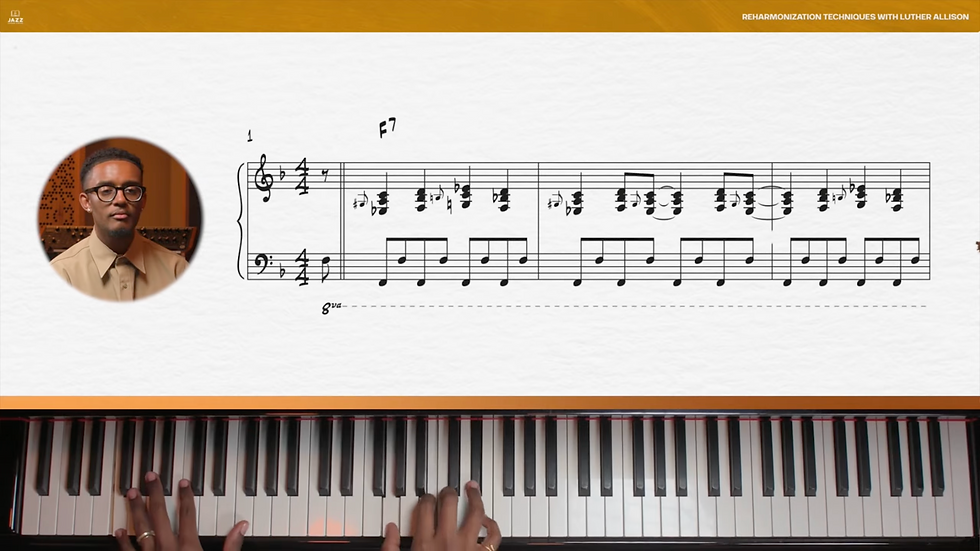


If we take this over time, you start seeing more jazz blues, as we'll call it. You kind of have the “blues blues,” and the “jazz blues,” for lack of a better term. And you're seeing more melodies like Billy's Bounce or Now's the Time being composed over a blues form. And sometimes you're seeing ii-V-I progressions being added into the blues.
Now you see your I chord, and you might jump to the IV chord in the next bar, back to your I for two more bars. The next four bar sequence is probably IV chord for two bars, back to your I chord for two bars, and then instead of doing V down to IV for a bar. You'll have ii7 to your V to your I-vi-ii-V-I.

So in this example, let’s look at a little bit of Straight No Chaser, comping through some simple voicings over the blues, starting with the earlier style, and then for the next chorus, using a slightly later version where we start to add in the ii-V-I at the end of the form. You're going to the IV a little sooner, back to the I, and then we’ll have more afterwards using some side slips, and we'll talk about some of that stuff more afterwards.
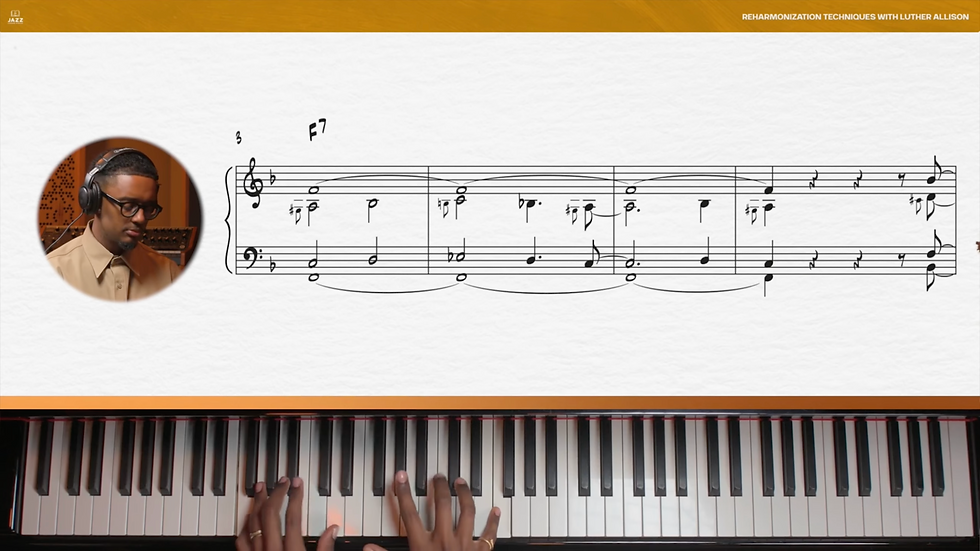


The blues is also really, really flexible. There's a lot that we can do with it. We can obviously just stay on the I chord for a while for those first four bars. Move to our IV chord for two. Back to our I. All the things, as you could see earlier in that example, there are some times where we have iii-vi-ii-V and a turnaround.

We can also do some other slick stuff where we’re adding some side slips in there.

From the I chord, and going into the IV chord, we can add essentially a tritone sub. If we were to make the I chord from a regular dominant to maybe an altered dominant, which is going to give some tension leading down to the four chord, we can also do the same thing over B7.

So there, we’re kind of moving a shape down.

To the IV chord in whole steps, you can do the same thing here.

Or we could side slip to the IV from a half step below.

You have a few options there. Same going back to I.

We can do a half step, iii-vi-bIII-bVI to ii. There's a lot of options that you can use.

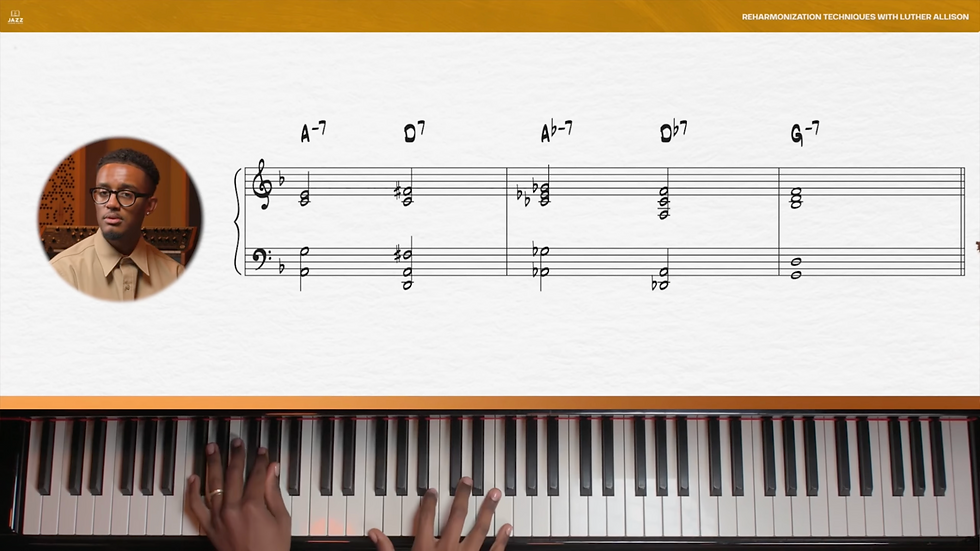
There were a couple of points where we made the IV chord a ii within a ii-V-I sequence.

When we go Bbm, Eb, Ab, Db7#9b5, then we could, if we want to, do a B7 up to a C7, back to F7.

And we can do E, A, to Ab, kind of going crazy with the side slip ii-Vs.

So instead of Bbm to Eb7, Ab to Db7, we could do Bbm straight to my A7 to Ab, or we can add a ii before the A.


Well that’s all we have for today, but if you want to get into even more of this, make sure to check out our 30-Day Reharm Chops course! Plus if you want to see how Luther plays through anything we talked about, make sure to check out our accompanying YouTube video, Reharmonize the Blues and Boost Your Harmonic Language (feat. Luther Allison).
We’ll see you next time!


Comments