Nailing Bebop Changes with Kellin Hanas
- Jazz Lesson Videos

- Apr 22
- 3 min read
Bebop is all about slow, focused repetition, connecting ideas through real harmonic movement. But let's define what bebop is first. Bebop is the sound of 1940s jazz—fast, harmonically rich, and full of forward motion. It's built around chromaticism, enclosures, voice leading, and rhythmic variation. All of those little details make the lines weave smoothly through all of the changes.
When you understand these building blocks, you're not just learning licks, you're learning the jazz language that improvisation is built on. Today we’re going to look at something really special, our brand new Bebop Bootcamp course from Jazz Lesson Videos. This course is about helping you build real bebop fluency step by step using the same techniques and tunes that bebop legends such as Charlie Parker, Dizzy Gillespie, and Bud Powell used.
If it’s helpful to see how Kellin played through anything we talked about today, make sure to check out our accompanying YouTube video Nailing Bebop Changes with Kellin Hanas.
So let’s get playing!

So that was over Confirmation. Let’s talk about how we can use some bebop techniques.
We're looking at the last two bars of the second A section.

Here we use some enclosures. In the second bar of that line over the Fmaj7, we use an enclosure between the and of 1 and the and of 2.
We play an enclosure on that G#, and in the first bar of the line, you see that we’re utilizing the bebop scale. In those first two beats, we have a D dominant bebop scale.
Another concept that’s present here is motivic development, specifically in the pickups to the first bar, the first bar itself, and the second bar.

You can see that we take that motivic idea and play it two more times after that. In the second and third times that we played it, we moved it down to fit the harmony. And the third time we played it, we just displaced it a little bit so it sounded different rhythmically.
A good way to practice motivic development is to take the same idea and play it throughout the chorus, but use different notes depending on the harmony. Another great way to practice this over a standard is to do a kind of call and response exercise with yourself. Play for two bars and then try to respond to the phrase that you just played with another phrase, maybe something like this.
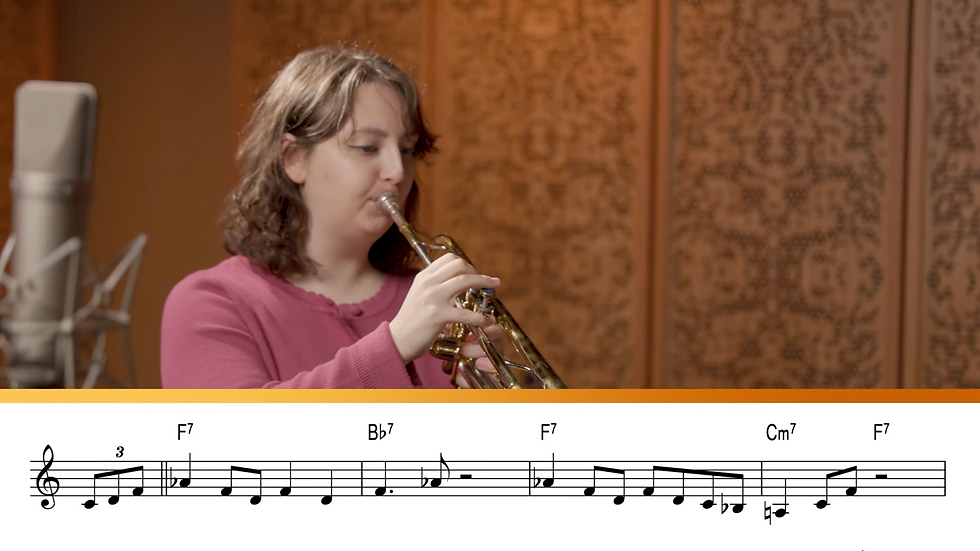
You might be seeing these transcriptions and thinking, “how am I supposed to apply these lines to my own playing?” Well, one of the things that Kellin did when she was first starting out is taking the solos that she transcribed and doing what she calls the “application process.”
It's basically where you find lines that you enjoy from the solo, you pick them out, and you decide to put them in your solos and then improvise off of them yourself. So we can take a look at the solo on Confirmation. Let's find a line that we really like, and let's see where we can go with it. From there, let's return to a line that we played earlier. It's the last two bars of the second A section on the solo of Confirmation. The original line looks something like this.

Now for yourself, you want to start your line with the beginnin—how Kellin played it, and then maybe go off somewhere else with your own ideas.

And it doesn't have to be as complicated as that. Either you can start very simply with chord tones or other simple things that we mentioned earlier, but the idea is to get yourself comfortable with starting to improvise, even if you don't like what you're playing at first. It's way better to start doing it and get used to it.
Let's check out another line—the last four bars of the bridge of Kellin’s first chorus on Confirmation. Here’s the original line

We'll start with that, and then go off somewhere else.

A really good way to do this, and a way that Kellin started doing it when she was beginning, was writing out the lines and seeing how they all fit together. Seeing the voice leading physically is really, really helpful.
Well that’s all we have for today, but if you want to go even further, make sure to check out our Bebop Bootcamp course. And if you want to see how Kellin played through anything we talked about today, make sure to check out our accompanying YouTube video Nailing Bebop Changes with Kellin Hanas.


Mastering bebop changes requires such a disciplined approach to harmonic movement. For those interested in discussing jazz theory or sharing practice notes within a focused microblogging environment, the community there offers a quiet space for reflection away from the noise of larger platforms.