Advanced Jazz Vocabulary, Explained (feat. Alex Wintz)

Moving from an intermediate guitar player to an advanced one is tricky. Most intermediate players have solid technique, a good grasp of theory and plenty of scales under their fingers, but when the harmony starts moving, their solos are still built mostly on general licks and scale patterns. Instead of thinking of predetermined licks, advanced players sound different because they're working with advanced vocabulary—concepts like upper structure triads, triad pairs, superimposing arpeggios, diminished concepts, and m7b5 voicings
All the concepts and examples we’re going to look at today come directly from our resource Advanced Vocabulary Concepts. Here, you'll find a focused system for developing advanced jazz vocabulary concepts that bridge the gap between theory, technique, and real musical application. Each core concept has five patterns, five phrases and one Etude applying the concept to a jazz standard.
Plus, you can follow along with what Alex is playing today on our accompanying YouTube video, Advanced Jazz Vocabulary, Explained (feat. Alex Wintz).
Let’s get playing!
Contents
Upper structure triads
Let’s start by thinking about the simplest ways to get to advanced sounds.
A lot of times we like to start with a scale, but the scale gives you seven options of notes, and a lot of times that will not provide the same level of clarity right away to get into the sound of a specific, more advanced chord voicing.
That's why it’s good to begin by looking at upper structure triads. Upper structure triads essentially refers to a different triad than the root. When we look at different chords that look complicated, a lot of times it is just a triad on top of a different bass note. Here's our first example.
We're looking at a chart, and the chord says C13b9. And when Alex first started learning this chord and playing on guitar, he could see how he could get to a shape that sort of equaled this.

Okay, so here's C…we can play Db which is the b9, the 3 which is E, the 13 which is A.
But that’s a lot of steps to think through. So if we just look at it deeper, we can see that we’re actually playing a triad on top of a bass note. The triad here is A over C. The notes of A major give us the 13, b9 and 3, respectively.

So let's think about this as a formula so that we don't have to even think so hard about it. Every time we see a chord like this, where we want to use this in substitution for a seventh chord to get to the sound of a 13b9 chord. You can play the major triad a minor third down from the root.
So we have our A over C, let's play a two octave A triad on top of it.

Now when we’re looking at a chart, and see Amaj7#5, it doesn’t have as many tones going on as the 13b9 chord, but it’s still complicated.
Let's try to find the triad that makes up that chord. And there it is, over C we have an E triad. E is the 3 of C, Ab is the #5, B is the 7.
That gives us all the sounds that we need to make a Cmaj7#5. So let's play the chord and then try to create a two octave E major triad.
The formula to figure this one out would be going up a major third and playing the major triad from the root.

Here's a two octave triad.
Now let's take a different Lydian chord. We’re looking at a chart and come across a Cmaj7b5913. That’s a huge chord, but it’s really just a triad on top of a bass note.
When we identify those tones that are needed, we get this triad a D triad over C, instead of Cmaj7b5913.

There's also a formula to understand to try to get this so we can do it in other keys as well. D major is a major second up from C. You might also call this chord a #11 9 13.
Let's pick another one. This is C7#9#11. For a lot of guitar players it's easier to play this as a chord than it is to play the sound linearly with single notes. But to get this sound, we just need to identify the triad that's within this chord.

And we’re seeing this as an Ebm triad over C. Eb gives us the #9, Gb gives us the #11, and Bb gives us the b7.
Our formula then would be to a minor triad a minor third up.
One way to think about this and figure out more of these formulas is just to take one triad, like C, and just change the bass note underneath it and see what sort of tones it outlines. And as you do this and follow the same guidelines, you're going to have your own set of ways that you can express a lot clearer and more organized the sound of these more advanced chords.
Another thing you should do with these is try to write out some lines over ii-V-I progressions as a way to make sure that you have internalized what you have studied. So let's do some now.

Here’s a ii-V-I, in the key of Bb, and we’re playing that D triad over F to give us F13b9.

Hopefully now you can see that to really get into advanced vocabulary, it's actually understanding the simplest concepts, such as triads, at a rather deep level. The deeper you get into understanding something like organizing triads, the easier it gets once you add more notes on top of it, arpeggios, scales, etc.
Let’s look at a couple of the things Alex did in this Etude as examples that you could try and create your own line or patterns on it.

In bar two, instead of it just being Ab7, or sometimes people play Abmaj7, we used a Bb triad to give a more #11 Lydian sound.

In bar four, we have an Fm triad to give that #9#11 sort of sound.

When we get to the pedal points and we're in the F pedal, we have a D major triad to convey a b9 13, sort of sound.

And another one is the chord that is Bb7b9 towards the end. Usually that's a Bb7b913, and we know that we can use a G triad to get that sound.
Triad pairs
For our next topic, we're building upon the ideas that we learned before, and that's taking upper structure triads. But instead of just sticking with one triad, we're creating triad pairs—two different triads on top of a root. That gives us even more of the sound of a type of chord. There's a lot of options of triad pairs.
And we can use any sort of triad, major, minor, augmented, diminished.
Our first example is for a sort of mixolydian sus sound.

So if our bass note is C, the triad pairs will be B flat and C,
So if we mix these up, it adds this nice kind of sus sound. The Bb triad gives us a sus4 with the 9 sound, with C of course, giving us the root. You can cycle between these in different ways and mix them up.

The formula to remember this would be a major triad and another major triad a whole step down.

What if we take a Lydian sound and make it into triad pairs that use a major triad, a major second up.

This is D over C and if we pair this with the root position C triad, we get a nice sort of Lydian sound, because that D triad gives us the #11, 13, and 9. And we can come up with different ways to mix and match this.
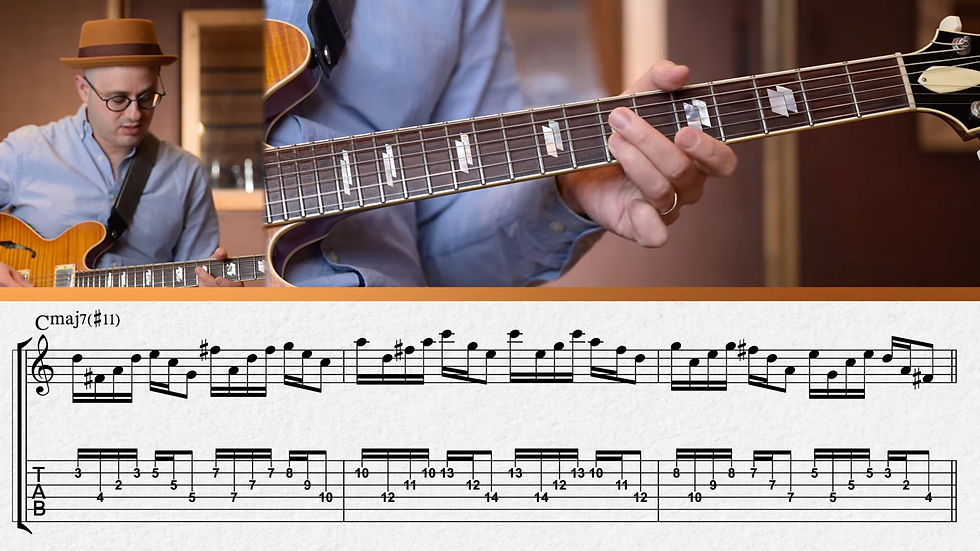
Once we understand the formula (major triad up a major second). We can work it out in different keys. Let's say we see this chord on a lead sheet, and want to write out some lines on them. That's something you should definitely try, too.
The best way to internalize these sort of things is to write them out over ii-V-I progressions, or, even better, over a song that that you know well, so you can kind of try to add a new ingredient to your improvisational toolbox.
Here are some ii-V-I lines to try using triad pairs.

This one is using the sort of Lydian triad pair on top of the dominant chord.
Pentatonics
This is a concept using scales you may be familiar with already, the minor and major pentatonic. We’ll introduce some other options of pentatonics, because remember, the pentatonic scale is just a word for five notes. There's going to be a few of these that you may not be familiar with.
Let's start with the ones that you're familiar with already,

The minor pentatonic scale.
We know how valuable it is as a tool for soloing. That pentatonic scale can be used and superimposed as well. So playing C minor pentatonic, let's say we're in this key of C minor.
What would happen if we're in the key of C minor and we play the D minor pentatonic?

This is superimposing and layering pentatonics. That D minor pentatonic scale gives us D the 9, F the 11, G the 5, A the 13 and C. So we have nines, thirteens, elevens—all different sounds than what we would get in the regular minor pentatonic sound.

So we can mix and match those.

That's something we can work out in all 12 keys and try out on different songs. When we play minor chords, the tendency is to always drift into playing m7, but in a lot of ways, the m6 sound can sound a lot more like tonic minor.
We can express when we see minor as as minor sixth. And there are two pentatonics associated with that. The first one goes like this.
Our notes here are 1, 2, b3, 5, 6, and back to 1.

Any of the patterns that you might have learned for minor pentatonic or major pentatonic, try with this m6 shape.

Let’s check out one more pentatonic scale you may not have thought of, and that involves this infamous m7b5 chord, which we don’t always think about having a good concept of something we can play.
There's a pentatonic associated with that too. Looking at Em7b5, we have the Em7b5 pentatonic, 1, b3, 4, b5, b7.

All the notes that we need to get a really nice sound on a half diminished chord. And again, this can be something where different patterns that you might have learned you can use for this m7 one.
Let’s check out some of the lines Alex wrote out for this so that we can discuss these ideas.

We have a ii-V-I in Eb major. But at that Bb7, we’re playing what you could say is Db minor pentatonic, or you could say it's E major pentatonic. We’ll look at E major pentatonic as a way to resolve to tonic.
Well that’s all we have for today, but if you want to dive even deeper on these concepts and more, make sure to check out our resource Advanced Vocabulary Concepts, as well as our accompanying YouTube video, Advanced Jazz Vocabulary, Explained (feat. Alex Wintz).


Comments