It’s not your lines, it’s how you practice them! (feat. Cecil Alexander)

Today we're going to look at a transcribed cell that we're then going to apply to a pattern through the scale.
So the cell looks like this:

and this is just an idea that Cecil got from John Coltrane. This cell is just 1, 4, 5, and you can apply that to a lot of different scale types, just because it's so ambiguous harmonically. But here, we'll do it with the major scale.
So we have 1, 4, 5 on C, and then you can take it through the entire scale from there.

You can even do descending cells, so 5, 4, 1.

And because it's such a small cell, it's so easy to think of moving around the scale in different positions, different string sets, that kind of thing.
Next up, let's see how we can use this cell in context over a minor chord vamp. If we were to have, for example, a static Cm7 in a modal context, we can really quickly use this cell and other cells that we know, like the 1, 2, 3, 5, for example, to slip in and out of the harmony.
If we wanted to do some side slipping, that'd be a half step up or half step down,
Or we can move in thirds

There’s minor thirds, then major thirds:
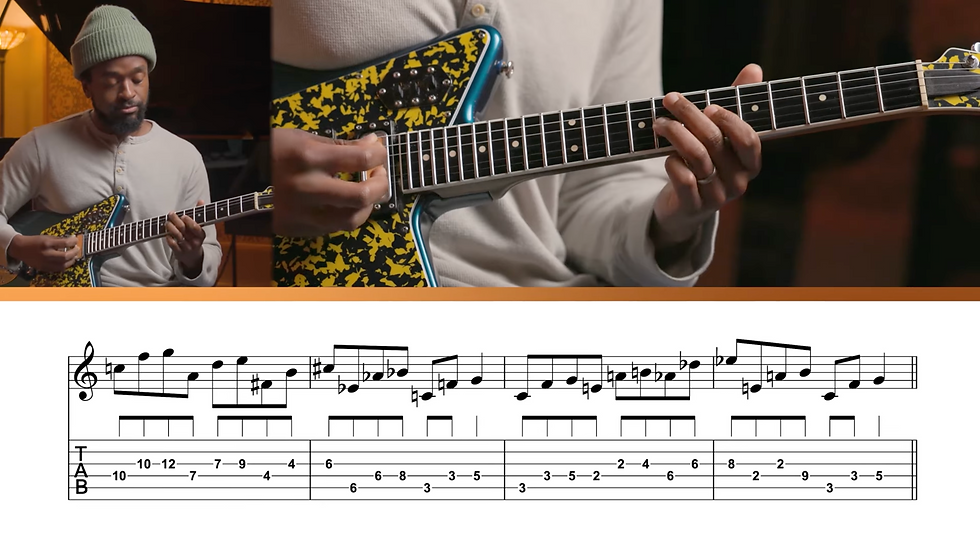
That generates all sorts of different tension, and you can use these to really quickly modulate between different keys over a static chord.
You may also spend some time trying to voice lead with it and use it in the middle of longer diatonic phrases, so we might play a bebop-derived idea…

and then end on that three notes.
We could also try slipping up a minor third to Eb, but still, we’re just trying to use it in the middle of lines to extend them.
To close out today, we're going to take a look at using some of these cells over the tune Impressions by John Coltrane,


Well that’s all we have for today, but if you want to dive even deeper into things like this, you’ll want to check out our 30 Day Jazz Vocabulary Boot Camp, which has these concepts and more with a structured day-by-day practice plan.
And if you want to see how Cecil played through anything we talked about today, make sure to check out our accompanying YouTube video, It’s not your lines, it’s how you practice them! (feat. Cecil Alexander).
We’ll see you next time!


Comments