Playing “Out” With the Whole Tone Scale (feat. Ryan Devlin)

Today we're going to be talking about one of the most exciting, but also one of the most misunderstood areas of jazz improvisation—playing outside of the chord changes. Every example you'll hear today comes from our resource 30 Day Outside Improvisation Bootcamp. In this course, you'll find approach notes and enclosure for targeting both inside and outside tones, pentatonic systems for creating modern tension and color, melodic minor language, as well as altered, diminished, augmented, and whole tone sounds, chord substitutions, and harmonic movement for advanced improvisation. If you want to develop the ability to start phrases outside of the chord changes, control your tension, and resolve with authority, make sure to check it out.
And if you want to see how Ryan plays through anything we talk about today, make sure to check out our accompanying YouTube video, Playing “Out” With the Whole Tone Scale (feat. Ryan Devlin).
Now let’s get playing!
We use symmetrical scales like the whole tone scale to gain some outside tension. Today's focus is going to be on playing the whole tone scale throughout patterns and knowing where to apply them. So, for our warm up, we're just going to play one whole tone scale pattern through two of our whole tone scale keys.
Now there are only two whole tone scale keys, because it's a symmetrical scale that has six notes and 6+6=12. Those two whole tone scales cover all 12 of our notes. What we mean by them being symmetrical is the pattern that you build the scale in is all the same intervals, so the whole tone scale is all whole tones.
So, if we started on G—G to A, A to B, B to C#, C# to D#/Eb, Eb to F, F to G, and we’re back. Then if we wanted the other six notes, we would just go up a half step, Ab to Bb, Bb to C, C to D, D to E, E to F#, F# to Ab, and that would cover all 12 notes. So, there are only two whole tone scales to learn. Now, when we start applying this to different progressions, you'll have to memorize them based on the root of a certain chord. We'll talk about that in a second, but for now, for this exercise to warm up with, we're going to play both whole tone scales up and down in its linear order, and then we're going to practice this pattern. So, this is the pattern that we're going to play through our two keys of whole tone.
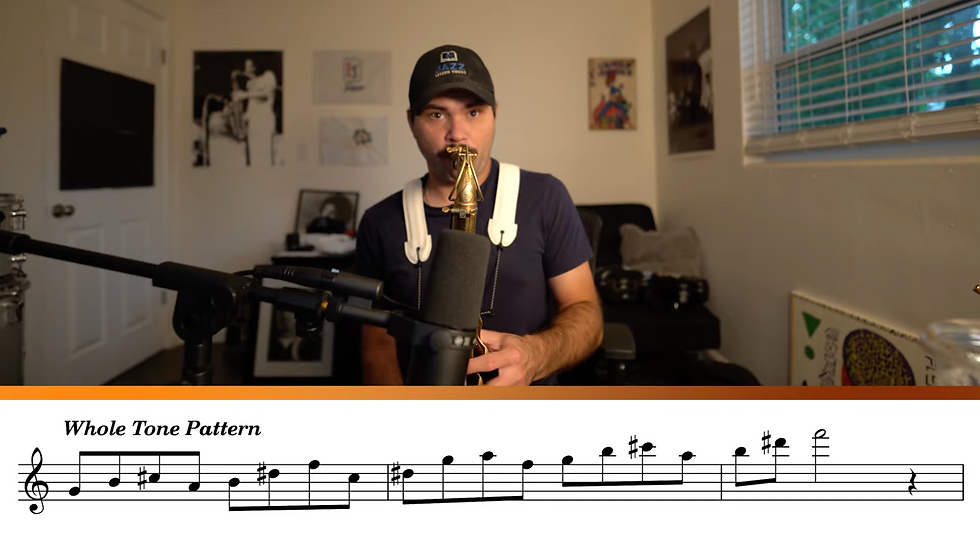
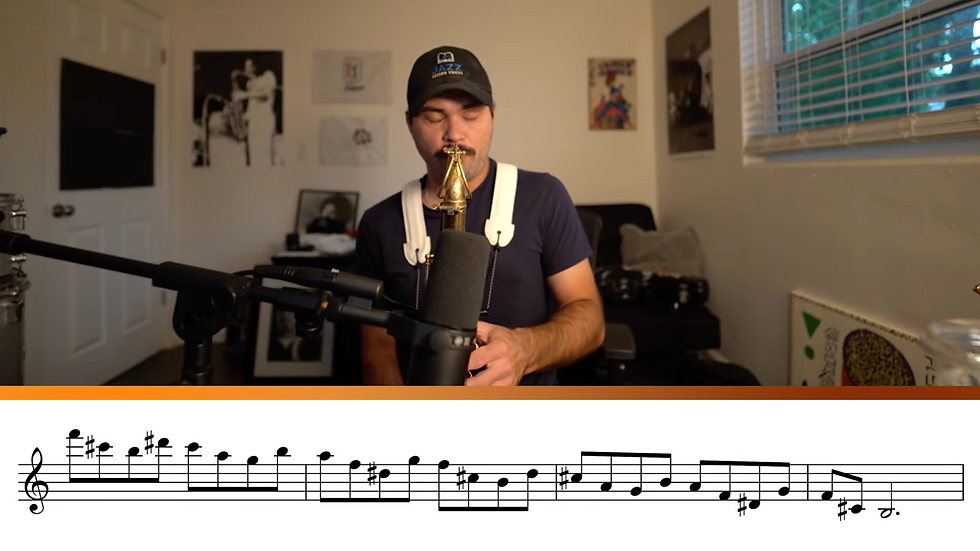
So basically, we’re using this four note cell, right? In our first key we have G, B, C#, A, B, and the pattern repeats itself, and we do that through all tones of our whole tone scale. So we start on the first note, third note, but we're skipping a couple notes. We first play off the root, then we play off the third, then we play off the fifth. So the pattern has a couple of these skips and steps. We talk about this when we play pentatonics, and it works similarly with these hexatonic scales. You can think about the pattern in the skips and steps. Anything that's not in our linear order of the scale, we can think of as a skip. Anything that is in the linear order of the scale, just going up in whole tones or down in whole tones would be a step, so G, B, C#, A, would be skip up, step up, skip down, and you just play that on every single tone of your whole tone scale, and then when you descend, it's the exact opposite, you go skip down, step down, skip up.
Now let's do it in our other key.


This is a great one to warm up on, it gets the whole tone scale and all 12 keys under your fingers without just playing in linear order, this gives you a pattern to play. So moving on, we’ll take these whole tone scale patterns and play them over dominant chords.

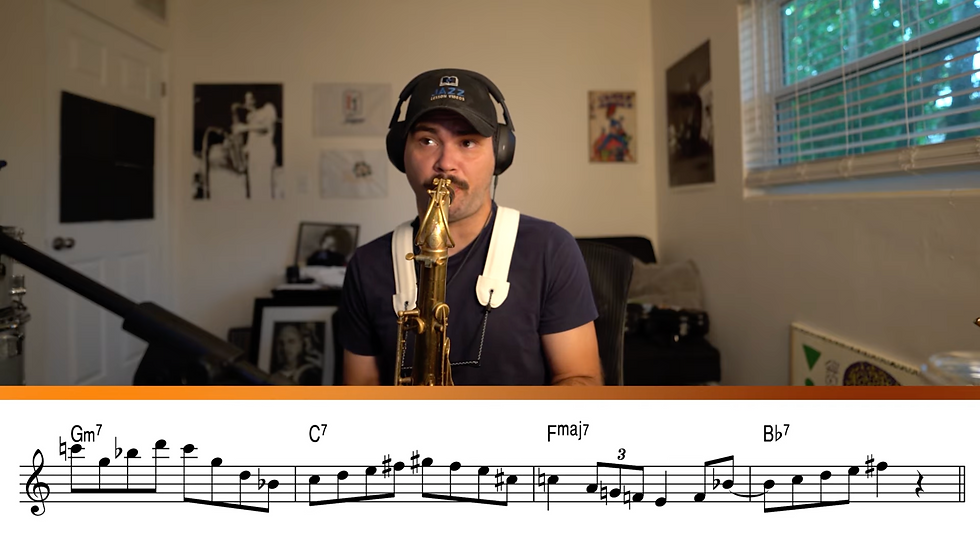
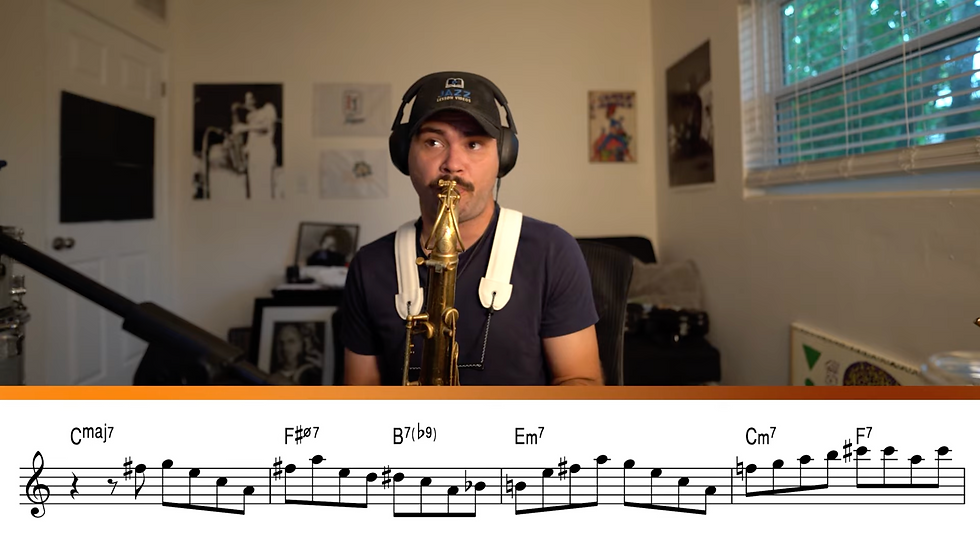
It’s good to apply these to dominant chords and play the whole tone scale from the root of the chord—so if we have a G7 chord, we're going to play the G whole tone scale, that would be our sound. If we had the Eb7, we would play the Eb whole tone scale, which is the same thing as the G scale, but it’s good to use this in a “movable Do” kind of way. So Eb whole tone over Eb7...why does this work? Well, let's go back to G, to make it a little bit easier. In G whole tone, we have G, A, B, C#, Eb, F, and G. So in the context of G7 we have a root, 9 (2), and 3, the #4/b5, the b13, and the b7, so we have four notes that are inside of our key and two notes that are outside. It has this really cool, like, hybrid tension sound. It’s fun to play this on a ii-V-I where on the ii chord you play inside, outside/whole tone on the V, resolve to the root.

You can also do this by just playing the whole tone over the ii and the V.
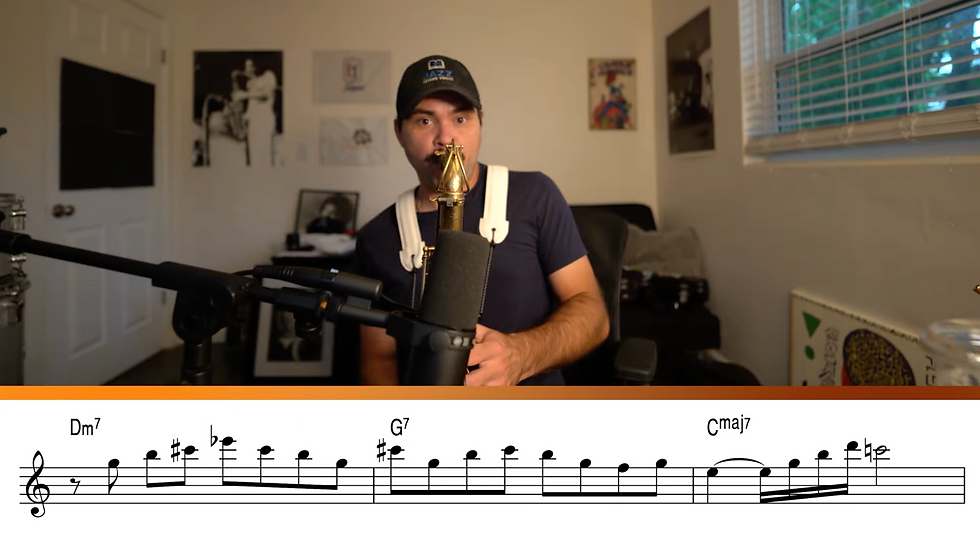

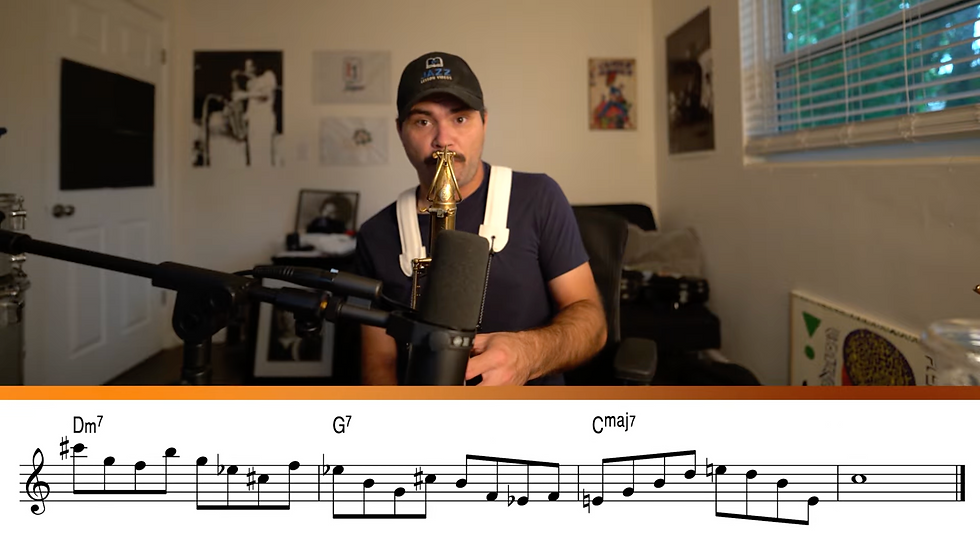
Let's apply this sound to “Stella by Starlight,” one of Ryan’s favorite tunes. On all of the dominant chords we’re going to be playing the whole tone scale from the root of the dominant chord.


Well that’s all we have for today, but if you want to dive deeper on this, make sure to check out our 30 Day Outside Improvisation Bootcamp. And if you want to hear how Ryan plays through anything we talked about today, check out our accompanying YouTube video Playing “Out” With the Whole Tone Scale (feat. Ryan Devlin).


Comments