How to Approach Standards in Major Keys (feat. Cecil Alexander)
- Jazz Lesson Videos

- Jun 15
- 5 min read
Today we’re going to talk about something that doesn't get discussed enough in jazz education—why playing convincingly in major keys is one of the hardest things to do. Most jazz standards are in major keys. When you look at the Great American Songbook, so many tunes resolve to a major tonic chord, and the overall tonal center is major. And yet, for most players, major key improvisation is where things start to feel exposed. Many players feel more comfortable in minor and dominant key centers, as major key language demands a higher level of precision and intentional voice leading. If you can make a major key sound strong, melodic, and convincing, everything else in your playing gets better. Today, we’re going to break down five core concepts taken directly from our new resource called Jazz Vocabulary for Major Tonality, and show you how to master this deceptively difficult sound.
If you want to hear how Cecil plays through anything we talk about today, make sure to check out our accompanying YouTube video, How to Approach Standards in Major Keys (feat. Cecil Alexander).
Now let's get playing!
We're going to check out major vocabulary phrases over a walk-up progression that uses chromatic diminished passing chords.

For our first phrase, we're going to be playing this over the progression of Bb major to B diminished, so that's the b2 or #1 diminished to ii7 to b3 or #2 diminished moving into iii7.
So, with this phrase, we're just going to be playing diatonic to each of these chords. So we have this phrase on Bbmaj7 moving down a half step into B natural, which is going to be the root of that Bº7. And with that B, we're targeting Cm7, so you know Bº is functioning as a quick V7 to Cm7 like so G7 to Cm7, and we resolve to the root of Cm7, kind of anticipating it by an eighth note, the “and” of four. We also have that little diatonic enclosure, B, E, C, then after that on Cm7, we’re just grabbing the 5 and the b3, and then we have that same diatonic enclosure going from C#º to Dm7, so that C#, E, into D.
With our second phrase we're going to be incorporating a little bit more chromaticism over the progression.

We start on the major 7 of Bbmaj7, and we have this phrase, going up from the 7 to the root, back down to the 7, chromatic into G, which is going to be the bb7 of Bº7. Then we have more chromaticism, so G, F#, F, targeting the 9 of Cm7. Here's that first measure, that gives us the minor 9 on Cm7, and then we leap up to the 4, and we have kind of this little harmonic anticipation of that C#º7 sound, right? So that's kind of anticipating it by one beat by incorporating that E natural against Cm7. That creates a pretty big dissonance, but because it's a harmonic anticipation, you keep the forward motion going, and you don't really notice that major 3 over the minor chord. Then we go up a º7 arpeggio on C#º7, and then we finish by using this cool melodic shape. This also creates a little bit of harmonic tension because we have this C# on a strong beat, which belongs to the previous chord, as C#º, but then we resolve it in the next beat to the b7 of Dm7.

On this next phrase, we're going to be using rhythmic variation to create a little bit more interest over this line. We start by using a leap from the 5 of Bbmaj7 to the 3, and then we have the root to the bb7 of Bº7. We separate those by one beat each, and then on Cm7, we go down an arpeggio, and on C#º7, we grab the b3 and the 1, and then finally resolve to Dm7. We grab E, resolving into the root of Dm7, and then just this little diatonic melodic shape, that's 1, 5, b3, 1, 4, and then to the b3 again. With this progression that is kind of moving outside of the key center a little bit more, we're still tying everything that we do to the chord tones, so we're trying to highlight those as much as we can, even when we incorporate chromaticism and rhythmic variation that kind of blurs the bar lines, we’re still going back to those chord tones as much as we can.

Our next progression is going to be #ivm7b5 to the V7/iii into Imaj7, so kind of a deceptive cadence. We have Em7b5, A7 into Bbmaj7.
For our first phrase, we’ll go totally diatonic. We have the b3 being targeted on Em7b5, then targeting Bb, which is the b9 on A7 and just going down the scale till we get to D, which then becomes the 3 of Bbmaj7. Then we have this nice little embellishment leading into the 6 of Bbmaj7, so 3, 7, 5, 6.
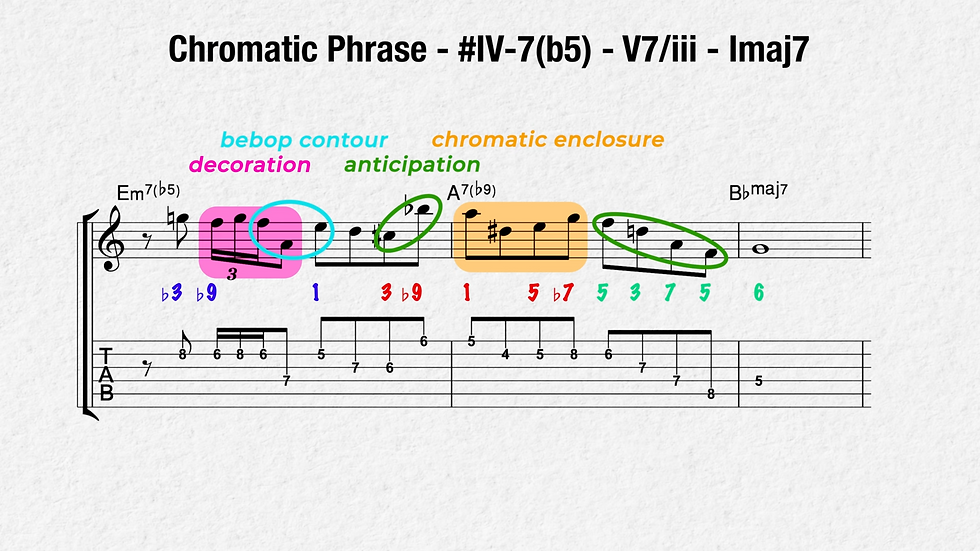
Then for our next phrase, we’re incorporating a little bit more chromaticism over the progression. We have this little idea that is going to start on the b3 again, like we did in the first phrase, hitting the b9 on Em7b5, but incorporating as part of this little decoration with the b3, a b9 to b3, back down to the b9. Then that bebop contour again, a diatonic 6 below, and then back up a fifth to the root, and then we anticipate A7b9 by one beat.
We're hitting this C#, which is going to be the 3 of that A7 up to the b9, and then the first note that falls on the change to A7 is the root. Then we have this little chromatic enclosure idea. It's one of Cecil’s favorite melodic devices to use, starting on the 1, chromatic into the 5, b7 into the b6. That little chromatic enclosure creates this nice crisscross shape melodically, and then anticipating the harmony shifting into Bb by two beats, we have a 5, 3, 7, 5, and then 6. Again, using harmonic anticipation to color things a little bit more.

And then on our final phrase, using some rhythmic variation, we first start on the “and” of beat 2. We have the root up to the b9 on Em7b5, and then resolving the b9 to the root using an enclosure, going down to the 3 of A7 and then another little syncopation starting the next excerpt of the phrase on the “and” of beat 2. There's that little contour again from the second phrase, which sort of crisscrosses a chromatic enclosure and then resolves into the 5 of Bbmaj7. Then we’re going down the scale from there, skipping over the 4, and landing on that 6 on the Imaj7 at the end. So again, we’re still going pretty far outside the diatonic harmony with this #iv - V7/iii, but we’re still just targeting the chord tones. We have that C#, which is going to be the most important outside of the scale note that's created by this progression. We target it in a couple different ways, using diatonic approaches, chromatic enclosures, and chromatic approaches, just to color things a little bit more.
Well that's all we have for today, but if you want to dive deeper into these examples and more, check out our resource, Jazz Vocabulary for Major Tonality. And if you want to hear how Cecil plays through anything we talked about today, make sure to check out our accompanying YouTube video, How to Approach Standards in Major Keys (feat. Cecil Alexander).
We'll see you next time!


Key points about major keys! I've struggled with this too. I'm also working on learning piano chords, haha. I'm a beginner and I've been trying to memorize chords by rote. I looked at the B♭ major chord, and I'm not sure if this approach is right.