How to Actually Use Altered Harmony (feat. Luther Allison)
- Jazz Lesson Videos

- Jun 12
- 3 min read
It’s easy to say that you understand altered harmony, but oftentimes people will be less certain about how to use it. People often do not understand how and when to use this in the context of playing a standard or playing with other musicians.
Everything we're about to talk about today comes from Luther’s resource with Jazz Lesson Videos, 30 Day Jazz Harmony Chops, which has a simple day by day plan, where every session focuses on three things: a technical warm up, a harmonic concept, and a direct application to a tune. Everything that we cover is accompanied by sheet music, along with overhead video, so you can see everything in the moment. And by the end of the 30 days, you're going to have access to many different tunes, harmonic concepts, and you'll have tools to develop your soloing and comping as a jazz pianist.
And before we get going, if you want to hear how Luther plays through anything we talk about today, make sure to check out our accompanying YouTube video, How to Actually Use Altered Harmony (feat. Luther Allison).
Now let’s get playing!
One cool idea that you can use over your altered scale is using thirds—basically just playing through the scale in thirds. This is a scale that you can use over a #9/#5 voicing, or even a flat b9/b5 voicing.

In this context, we’re using it over this B voicing, which you hear this in a very famous tune by Cedar Walton, Hindsight.

And our scale is going to be…

Go ahead and take that through all of the keys, and you'll come up with some very beautiful sounds and approaches to playing over these altered dominant chords.

With each of your altered sounds and each of your altered extensions, there's going to be different sounds and tensions that are created, and the most important thing is making sure that each of these align with what's being played in the melody. So, if we look at Stella by Starlight…

You want to make sure you're understanding what each of these alterations sounds and feels like. There are certain ones that give more of a whole-tone sort of sound.

Understanding what it's derived from is going to help to give some more context for it.

Here’s A7 using b5 and b13 together, which gives a very dreamy sound.

It's not too grounded, and it almost doesn't feel like it has to go anywhere, because there's equal spacing between the notes, as you can see.

This voicing is mirrored, you have a major third and a major second. Same thing here, just the other way, mirrored.

The sus is a little more smooth, and there's something about even the b13 sound stylistically and keeping that pattern going b9/b5.
Sometimes it’s nice to use some of those other sounds coming out of something a little more consonant.

Here the melody falls on an altered note within that G chord, you have a couple of options.

You can make it an Ebmaj7/G, or it could be a G#9#5, or it could be an Abmaj7/G. But experiment with all the options you have. It could be a B/G.
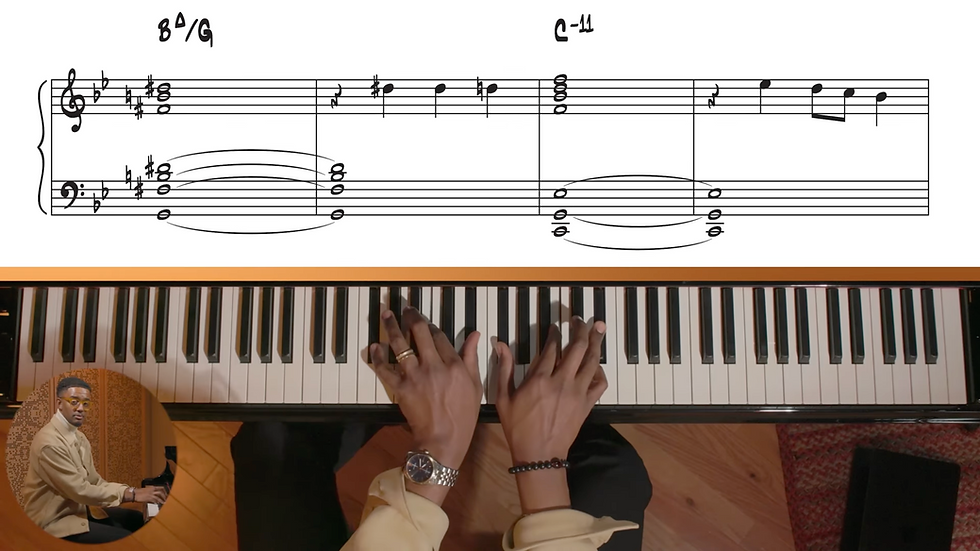
Let’s look at Stella by Starlight, and on some of these chords we’ll try to bring out some of the altered sounds on each of these voicings.


Well that’s all we have for today, but if you’re interested in learning more, make sure to check out our 30 Day Jazz Harmony Chops resource. And if you want to see how Luther plays through anything we talked about today, make sure to check out our accompanying YouTube video, How to Actually Use Altered Harmony (feat. Luther Allison).
See you next time!


Comments