Your Voicings Need This (feat. Luther S. Allison)
- Jazz Lesson Videos

- Mar 23
- 5 min read
Finding unique voicings is key to finding your sound, and there are some great tricks to help you find and remember those voicings. Today we’re going to look at a clear practice plan for developing real jazz harmonic concepts. It’s common for people to learn some of these concepts but not understand how and when to use them in context of playing a standard or playing with other musicians.
Everything we're about to talk about today you can find in our new resource 30-Day Jazz Harmony Chops, which will provide you with a simple day-by-day plan where every session focuses on three things: a technical warm up, a harmonic concept, and direct application to a tune. Everything that we cover is accompanied by sheet music along with overhead video, so you can see everything in the moment. By the end of the 30 days, you're going to have access to many different tunes, harmonic concepts, and you'll have tools to develop your soloing and comping as a jazz pianist.
If you want to hear how Luther plays through anything we talk about here, make sure to check out our accompanying YouTube video, Your Voicings Need This (feat. Luther S. Allison).
Now let’s get playing!
Contents
Sus chords
Sus chords are chords that are built off of your major triad, but all you're doing is moving the third up to your fourth. So for example, if we were to take an Absus:

We could start with just an Ab7 voicing, because it's also rooted in more of the dominant sound. We move the third up a half step.
Now in more pop contexts, or gospel or Americana and some other types of music, you might just hear them playing sus chords in place of a major chord.


Now, in more of a jazz context, we might add a little bit more color to this sound. A really nice way to get to this suspended sound, is by playing a major seven chord a whole step below the root. So if we take that Ab, we might play a Gbmaj7.

That gives us the dominant sound and the Gb that gives us the 9, 4, which is that sus sound, and the 13.
Now, another thing you could do is you could play a minor seven chord a perfect fourth below the root.
Same sort of thing, which is very closely related to that Gbmaj7, right?
We still have the sus 4, 9, b7, and this time with that chord, we have the 5 in there.
And even as you can see…


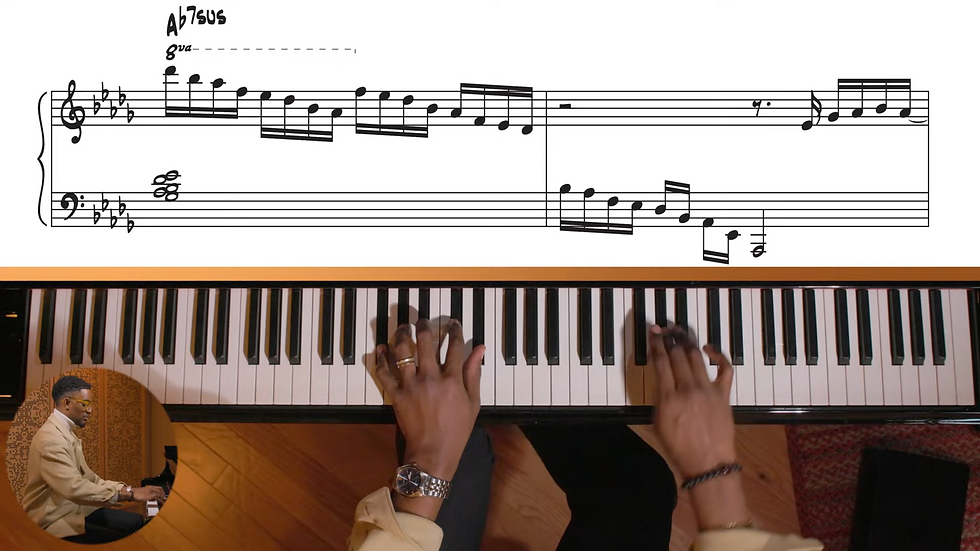
We’ve also got a lot of Bbm pentatonic language (or Db major pentatonic).
We’re also using a lot of language from Ebm pentatonic,


That's how we get the sus sound from there. Now you can play around with each of those chords in different inversions.

So your Ebm7 over the Ab in root position, first, second, and third inversion. Then we can start to fill out the rest of the chord. It’s cool adding octaves in the right hand as well, just to give a little bit more sparkle to the chord.
And normally that sus chord is going to be leading down a perfect fifth.

That's leading to the Dbmaj7. Then try that through all of your keys.

It's a very grand and big sound.


Block chords
Block chords are a very essential part of playing piano, particularly for harmonizing melodies, and also in your accompaniment. Whenever you're comping behind any instrumentalist or vocalist, it's a very beautiful, lush sound that exists within the octave.
It’s rooted in what some people refer to as the major bebop scale, which is a major scale incorporating a half step between your 5 and your 6.

Which within this, you have two different chords.

You have your C6 chord, but you also have all of the other notes of that scale forming a D diminished. And all we’re doing is alternating between each of these voicings so you have this.

And this.

You can just play everything straight through, like this.


It's kind of messing around a little bit with some of those block chords, but it's this a very, very nice method for harmonizing some of these melodies, especially diatonic ideas, and even if you want to play more vertical ideas, whether you're playing only horizontal or even some vertical stuff, it works very well in both of those contexts.
Planing
Planing is effectively just moving a sound through a certain key, but sometimes, whenever we refer to planing, it can also refer to taking the exact same sound and the structure of that sound, and it doesn't even necessarily go according to an overarching soundscape.
It's not like we're using fourths and only following them within the sound of C Dorian.

What if we were to take this sound do something like this?

We’re always using the exact same spacing between those notes. So even, as you can see, we’re using the sound that has a tritone at the top, and then everything else is in fourths.
So if we were to maybe take a song like this one…

And now we’re moving that sound with a tritone and all fourths below it throughout the context of that melody. We’re just planing that exact same sound, along with each of those notes in the melody. You can do that with so many different types of chords, so many different structures of sounds and chords, but that's the basis of planing.
Spread voicings
Spread voicings are much more open voicings—even larger than fourths and your classic third voicings and even these block chord voicings. One favorite that people oftentimes refer to as a Kenny Barron voicing, but you hear so many other pianists play this.
It's when you take fifths between each of your notes, then you go up a half step in the right hand, and you put fifths between each of those notes as well. So if we were to do this in F…

Then we go up a half step and add the rest. This creates a very beautiful spread sound. We have the fifths, but there's something about that cluster in the middle that adds a bit of a shimmer to the sound.
Now you can also do something like this.

Using some more thirds, but this time, we have our 3-note shell voicing in the left hand and we're opening up the sound.
Then we can continue these voicings in each hand and open things up. You can also have some inner voice movement within those voicings, too.

These are very open, dense, thick voicings that sound very nice in the meatier part of the piano. Now try to take some of those sounds through all of the keys.

Well that’s all we have for today, but if you want to see how Luther plays anything we talk about, make sure to check out our accompanying YouTube video “Your Voicings Need This (feat. Luther S. Allison)” as well as our 30-Day Jazz Harmony Chops course.
We’ll see you next time!


Comments