The #1 Concept That Transforms Your Solos Instantly feat. Ryan Devlin
- Jazz Lesson Videos

- Dec 17, 2025
- 3 min read
The most powerful secret to instantly improving your solos may be hiding in plain sight … and that's chord tones. If you know how to target the right chord tones at the right time, your solos will sound way more melodic, connected and professional, no matter what the tune is.

Today, we’re going to show you exactly how to implement this into your practice with real examples. But first off, what are chord tones? Chord tones are usually labeled as the 1, 3, 5, and 7 of any chord.

For example, if we have C major, that would be C, E, G, and B. Those are the notes of the chord that the piano player is playing and the bass player is walking. Targeting these notes in your improv is like following a roadmap. And when you target these at the right time, your solos automatically sound more intentional and musical.

Let’s take a look at how we can practice playing chord tones over a ii-V-I progression. This is going to be Dm7, G7, and Cmaj7. Here are the chord tones for each one of those chords.
Dm7: D F A C
G7: G B D F
Cmaj7: C E G B
The technique Ryan likes to use to practice and implement chord tones is pretending he’s a bass player. He’ll use triplet rhythms, quarter notes, and eighth notes to make his lines a little bit more melodic, but just sticking to our four chord tones per chord per bar.

The second step of this is to improvise with your chord tones along with the bass line by trading with yourself. So try playing the progression two times—first by walking the bass, second time by soloing with just chord tones.

Now you might be thinking, “this is great—I can implement this into my practice. The bass line thing is cool. I'm working on my time. I'm working on my harmony. But how does this improve my solos?”
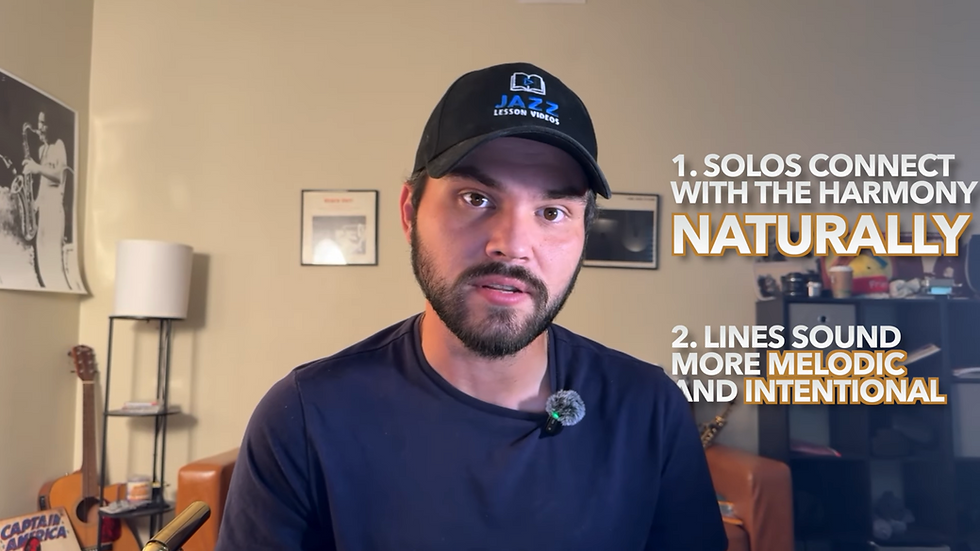
Well, when you practice targeting chord tones, a few things happen. First, your solos start to connect with the harmony more naturally. You develop a stronger ear for harmonic progressions, because you're associating the sound of these chord tones on your instrument with the sound of the chord that the band is playing, which makes it easier to improvise over any tune. And also your lines start to sound more melodic and intentional, even when you throw passing tones and chromaticism in, which can be added later.
Now how can we apply this to standards? That's where our resource comes in: 30 Chord Tone Etudes by Chad LB. He's put together this amazing resource that has 30 etudes written only with chord tones. We have two versions of each standard. One is what we call a chord tone workout, and the other is called chord tone connections.

A chord tone workout example is just playing our chord tones and making melodies that don't connect as melodically. Chord tone connections on the other hand use chromatic voice leading going from the one closest chord tone to the next closest chord tone in that next bar. Let's take a look at the chord tone connections example on “All the Things You Are.”

As you can see, when we're voice leading from Gm to Cm to F7, our chord tones that we're using are F (which is the 7 of G minor), to Eb (which is the 3 of Cm), then D (which is the 9 of Cm) to C natural, which is the 5 of F7.
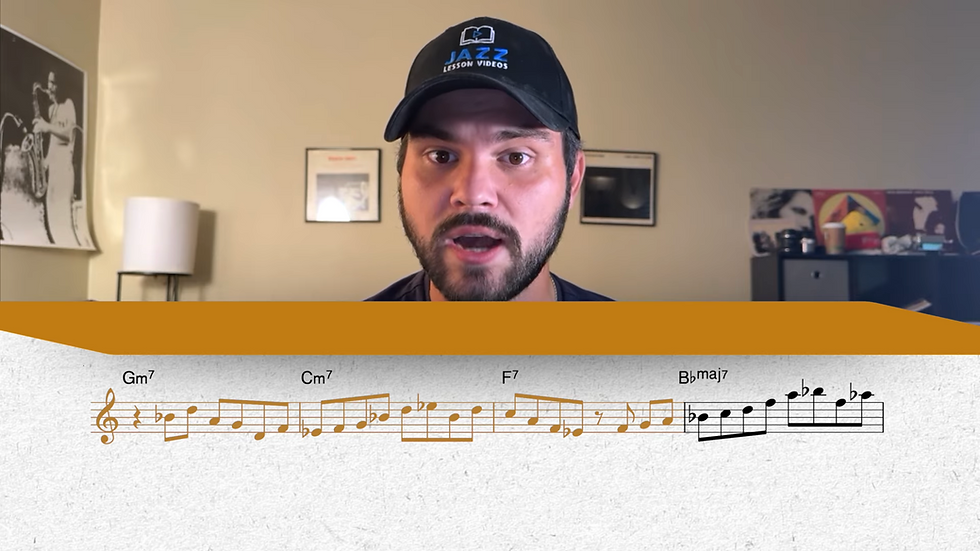
Quick disclaimer that the 9 (or the 2) is also considered a chord tone in some cases. So throughout this resource, if you see any 9s, they're considered chord tones for that bar. These are diatonic extensions.
Moving on to F7, we have A, which is the 3 of F7. That voice leads to Bb, which is the root of Bbmaj7.

That’s really melodic. You can sing the melody of “All the Things You Are” as you're listening or playing that etude. That is the point of chord tone soloing—you're growing your harmonic foundation as strong as possible, so it's easier to build things on top of that. The more you practice this way, you're going to be able to learn tunes faster, have better association with songs to progressions to your horn, and overall it’s just a great way to become a better improviser.
If you want to dive in further on this, make sure to check out our resource, 30 Chord Tone Etudes, and if you want to hear how Ryan plays through what we talked about today, make sure to check out our accompanying YouTube video, The #1 Concept That Transforms Your Solos Instantly feat. Ryan Devlin.
We’ll see you next time!


Comments