It’s Not You… It's Your Practice Routine (feat. Ryan Devlin)

When it comes to our growth as musicians, we're often held back by the very fundamentals we tend to overlook. Most of us know our major scales and have a general idea of how those scales fit on what chords, but when the harmony starts moving quickly, how do we actually apply that knowledge in real time? And if we're simply running scales over chord changes, are we really making music or just playing systematic patterns? How do we turn that information into something expressive, meaningful and musical.
More often than not, the issue isn't a lack of knowledge, it's a lack of clarity and practical structure. We're not always shown how to approach fundamentals in a way that directly translates to real musical situations. And as a result of that, our playing can feel really disconnected and unfocused, and that's exactly what we want to help with today.
Everything that we're going to break down in today's video comes from Ryan’s 30 Day Fundamentals course with Jazz Lesson Videos, a complete system designed to develop your technique and improvisational language in a structured, focused way. And every day you can practice along with him at your own pace. In this course, you'll find scales and their real world applications, learn to understand chord changes and construct strong melodic lines, as well as transcription and practical application of vocabulary along with memorizing and internalizing chord progressions. These are the tools that really help bridge the gap between knowing and playing so that your improvisation sounds intentional, musical and authentic.
Let's get playing!
Contents
Scales and applications
So now let's get into the first section of the 30 Day Fundamentals Course—scales and applications.
So let’s look at bebop scales. Now what are bebop scales? Bebop scales are like our major scale. So in the key of G, it would be G, A, B, C, D, E, F, F#, G. We're adding a note in between the sixth and the major seventh of our major scales, so it is an octatonic scale with eight notes rather than just seven. This octatonic scale works really well because it puts our chord tones onto our downbeats.

When we play in time, the beats we emphasize are 1 and 3 of every measure. That's where our chord tones are being hit, G, (A), B, (C), D, (E), F, (F#), G. Those are the chord tones of our dominant scale, and this specific bebop scale we're talking about works on dominant chords. So with the G bebop scale, G7 is the application to the chord, and G7 is the chord that you would play that bebop scale on. So we're just going to play our bebop scales up and down one or two octaves, depending on your instrument. No patterns yet, just working on playing our bebop scale in all 12 keys at a nice medium tempo.

Defining chord changes and building melodic lines
Now let's dive into concept number two. This is from week two of the course, and it's all about defining the chord changes and building your own melodic lines.
This is one of the concepts that people struggle with the most in their improvisation—how to embellish the chord changes in a musical way without just running up and down scales and arpeggios.
Let’s look at building our own ii-V-I lines. So we're going to combine a bunch of concepts that we worked on this week and make our own line. And you can use this blueprint to help you build your own lines away from this course.
So here's the blueprint on our ii chord. We're going to stay inside and use some melodic cell language. Maybe an arpeggio is a good idea. But we're going to stay inside on our ii chord.
Then when we get to our V chord, we're going to play some cells outside of our key. This is a good thing to implement when you're practicing yourself. You can even use the tritone substitution phrases from this course to do a tritone substitution melodic cell phrase, and then when you get to your tonic chord, you want to resolve on a big beat, beat 1 or beat 3, to a chord tone.
The theme is inside cells on the ii, outside tritone substitutions on the V, and then boom, hit your tonic chord.
Let’s look at a few different examples.


Sometimes it's good to have this broader blueprint and let yourself be the improviser or composer and write your own.
Don't worry about going through all 12 keys for this one, just one key. And then implement that blueprint inside melodic cells. Outside melodic cells resolve to your one chord. So have fun playing this and record yourself, then listen back. Maybe write down your favorite ones, then you can put those in all 12 keys!
Transcription and application
Ryan remembers as an undergrad asking his professors after every lesson—”okay, great. I've transcribed, but now what?”
This is something that a lot of people struggle with. We’re going to look at how to listen to a solo, specifically a Charlie Parker solo, grab the information from it and apply it to your solos. Ryan calls this targeted etude writing.
We’re going to check out Charlie Parker's solo on Donna Lee, exercising that active listening brain. We're going to transcribe a ii-V-I line from him and apply it to Donna Lee.
Listening to the solo, we’re trying to hear certain little enclosures and hear the key changes of the tune.
What we’ll look at is the way he ends on the iii-vi-ii-V.
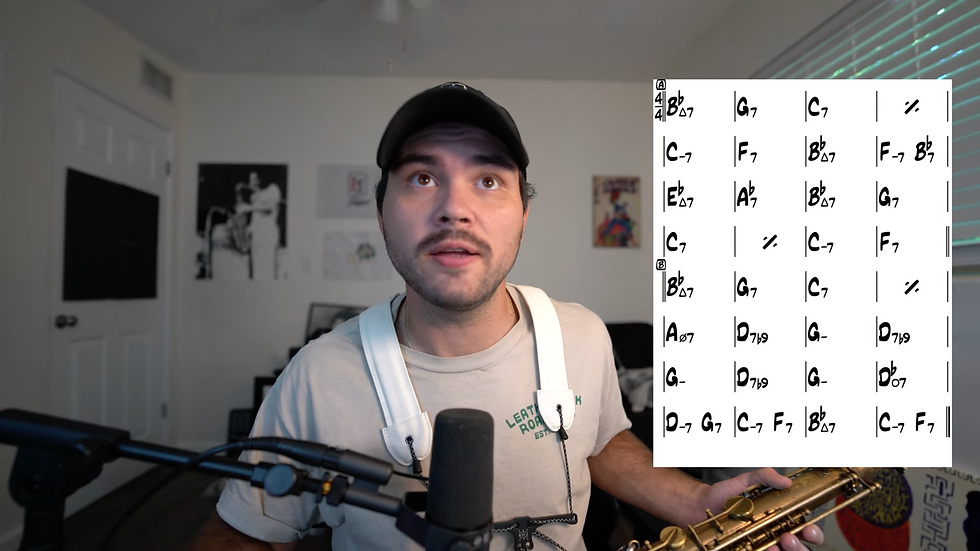
Looking at the chord chart here, we know that we're going into a iii-vi-ii-V and back to our home key, right? He's starting that phrase on our diminished seven chord of Db, and we're going into Dm, G7, Cm, F7, Bb.
So now we’ve actively listened to a line that we wanted to grab. Then we spent some time transcribing it, and now we're going to apply it to Donna Lee yet again, but this time, when we're applying it, there's only one place to apply this, right? Because there's only one iii-vi-ii-V, so we're going to play two choruses through Donna Lee, and we're going to aim for the last five bars to play that line. We'll improvise all around all the other parts.

Building a solo
Now let’s talk about building a solo. We've worked on scales and application, building our own lines, transcribing and applying them to our solos. What's next? Building a full solo.
We're going to talk about how to connect two and four bar phrases, ideas that we are already comfortable with and know well, but organizing them in a musical way that makes sense in the context of a full solo.
Let's check out the tune of Confirmation and try to connect ideas with enclosures.
A good way to think about this and approach it is to play 1 ½ bar or 3 ½ bar phrases that have to be connected with an enclosure. So, for example, if we’re playing Confirmation, and we play an idea on our tonic chord and then we need to get to the half diminished seven chord of C#m7b5 to F#7b9.
Now we’re thinking “how can we enclose a note to get there”. Let’s aim for the 3 of the dominant chord, which is A#or Bb. We’ll connect that and then play down the scale and get to the 3 of the Bm7. From there we’ll aim for the root of the Am chord.

We’re always aiming for a chord tone on a downbeat, and once we hit the chord tone on the downbeat, we start thinking about how we can enclose the next chord tone on the downbeat. It’s important to always be thinking ahead.

Breaking it down again, we’re going to play that first bar to A#, now to D, A.

To D, E, E, A, to F# of our Dmaj7 chord.
We’re using these little enclosures to connect our ideas like Lego pieces. They go from one thing to the next, connecting, connecting, connecting, until the phrase sounds super melodic and connected.

We’re using these ways of connecting from one chord to the next by adding chromaticism around chord tones. So chord tones are still the meat and potatoes of what we’re playing.

But if we play that same phrase and add some enclosures.

It just spices it up and adds some bebop flair.
Well that’s all we have for today guys, but if you want to dive even deeper on this, make sure to check out our 30-Day Jazz Fundamentals video course! And if you want to see how Ryan plays through anything we talked about today, make sure to check out our accompanying YouTube video, It's Not You, It's Your Practice Routine!


Breaking things down into smaller, focused sessions can make a huge difference in progress. For anyone preparing for certification exams in music or other fields, it's smart to know what to expect from testing providers. You can check out PSI Exams reviews to get a sense of how their testing centers and scheduling work. Being prepared for the logistics of an exam lets you focus your energy on the actual material and performance.