Applying Block Chords to Jazz Standards feat. Luther Allison

There are many ways to play jazz piano, but block chords are a particularly expressive tool that jazz pianists can use. Today we’re going to look at some of Luther’s favorite methods for practicing block chords on piano. These chords allow us to find unique ways to harmonize melodies on the piano, whether it be within the octave or also expanding outside of an octave.
A few key elements to mastering block chords on the piano are understanding voice leading and also understanding movement, whether it be parallel movement or contrary motion. We're going to cover all of these concepts, and we’re going to show you examples from our new resource, 27 Block Chord Etudes. In this, you'll find etudes designed to help you play melodies with full, harmonically rich block chords, practice voice leading across different chord types, explore chromatic approaches and upper structure voicings, combine different block chord concepts into flowing musical lines and apply these techniques over real jazz standards in the resource.
If you want to follow along with Luther playing anything we talk about today, make sure to check out our accompanying YouTube video Applying Block Chords to Jazz Standards feat. Luther Allison.
Now let’s get playing!
Contents
Planing
There are sounds that you can start to experiment with that aren't your traditional six chords or diminished chords. And a lot of this is something that Luther calls planing. So that’s taking a certain sound and moving that across a melody. So for example, if we were to take a song like Skylark, we could follow the melody with a specific voicing, and maybe we want the voicing to be like this.

And as you can see, this is based on fourths, but the top two notes are a tritone apart from each other. Let’s look at a brief example of something that Luther played and elaborated on a little bit more in the resource 27 block chord etudes.

So as you can see, we were just using that sound and planing it across the melody.

Now, if we wanted to use another sound, and this could be any sound that you want, one of them could be based in the “So What” voicings, as we call them.

And all that's happening is we’re keeping the same spacing between all of the notes, but just making sure that the melody is being followed through each of these chords.
A sound that Luther personally likes to use are very crunchy—a six chord with a flat nine.

So if we were to do the same thing in that song, which we also play this a little bit in the resource 27 Block chord etudes with this song in particular.

It could be any sound that you want.
Another sound that's very beautiful, is this sound—which is a major seven without the third, but you're closing the octave. This sound almost feels like a spaceship is lifting off. There's something about it that just feels like it's floating. And Luther likes using this whenever he reharmonizes a melody.
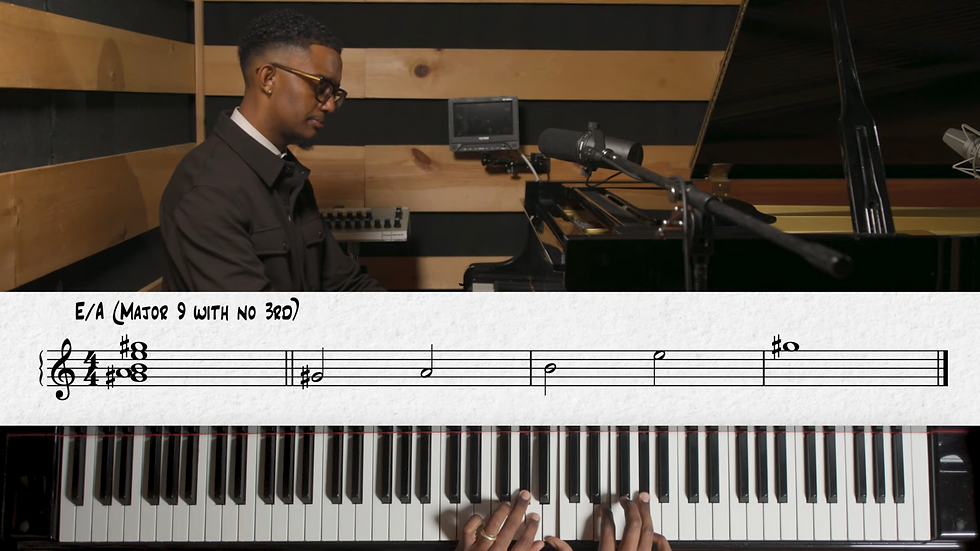
And then we're back home.
Contrary Motion
Another really great concept to mess around with on the piano is moving in contrary motion. So where we can move everything up or down diatonically...

We can also move outwards.

Here everything moved with the scale, but as we brought in new notes, we kept the previous notes that were played, so on and so forth. Moving this around the keys is going to be very important to get comfortable with it, and that's still based in our major sound. But you can do the same in your minor sound.

And one of Luther’s favorites, which is actually something he started to mess around with recently, is figuring out ways to use this over a diminished chord.

We’re actually using a different scale for this. If we were to take a G diminished chord, there are a few upper structure notes that sound really nice to add on to this voicing. So if I were to maybe add on a 9 and a 13. This gives us a really, really interesting sound.
If we look at this chord, a scale that we can use with this is going to be our whole-half diminished scale.

Just as we did before, we're going to move in contrary motion, but based in this scale. We’re also going to start on our 6, which is a very interesting place to begin—our #5 or b13, whatever you prefer to call it. And we'll move outwards based on that scale.

So that's using it as our diminished leading to our five chord (viiº/V). So if we’re doing a walk up…

We have a really beautiful sound that's rooted in a different scale, and it gives you a different feeling and texture, both harmonically and melodically.
Now you might have also seen Luther use this sound, which is also another block chord concept. We can move in the same direction and then break out into contrary motion. This is a sound Luther likes using on sus chords or minor 11 chords, and it's rooted in this sound.
If we have an Ebm7, we have our 9, 3, 5, and 7, and that's where we land. We start with this triad.

In playing with some of these sounds, moving in contrary motion is going to give us a completely different sound and feeling to the music.
Let’s try using some contrary motion within the context of a song.
This is “In a Sentimental Mood,” just the melody.

Now here is moving in contrary motion, where our melody is going to start on F, per usual, but our left hand is going to work its way down at random, but lands on B.

To close us out today, here are all of these concepts in action, along with many more ideas in the resource 27 Block Chord Etudes over the standard “In a Sentimental Mood.”

That’s all we have for today, but if you’d like to dive deeper into any of these concepts, you can check out the full resource 27 Block Chord Etudes, and make sure to check out our accompanying YouTube video, Applying Block Chords to Jazz Standards feat. Luther Allison.
We’ll see you next time!


Comments